
The Pressure Electroslag Remelting Process (PESR):How It Works and Why Pressure Matters

The Pressure Electroslag Remelting Process (PESR) is a specialised form of electroslag remelting performed inside a sealed pressure vessel. Like conventional ESR, it refines a consumable electrode through molten slag and controls the solidification of a new ingot. The pressure vessel adds control over gas pressure and atmosphere, which is especially useful when producing selected high-nitrogen and high-cleanliness specialty steels.
A steel grade tells you what alloy family you are buying. It does not necessarily tell you how the steel was melted.
That distinction matters because terms such as ESR, PESR and VAR are often presented as quality labels. In reality, each describes a manufacturing route with different metallurgical capabilities. The right route depends on the alloy, the intended component and the failure risk—not on which acronym sounds more advanced.
What Is the Pressure Electroslag Remelting Process?
PESR is an advanced variation of conventional electroslag remelting.
During standard ESR, a consumable steel electrode is lowered toward an electrically conductive molten slag bath inside a water-cooled mould. Electric current flows through the slag and generates resistance heat. The electrode tip melts gradually, producing metal droplets that pass through the slag before entering the molten metal pool below.
The refined metal then solidifies progressively inside the water-cooled mould, forming a new ingot. ESR furnace manufacturers describe the process as a secondary refining route used to improve metal purity, ingot structure and compositional uniformity.
PESR carries out this same basic operation inside a sealed pressure vessel. The operator can control both the pressure and composition of the surrounding atmosphere. Nitrogen is commonly used when the alloy has been designed to retain an elevated nitrogen content during remelting.
The pressure vessel is the defining feature of PESR. It does not replace the slag-refining mechanism of ESR; it adds another tightly controlled process variable.
PESR vs ESR vs VAR: The Short Comparison
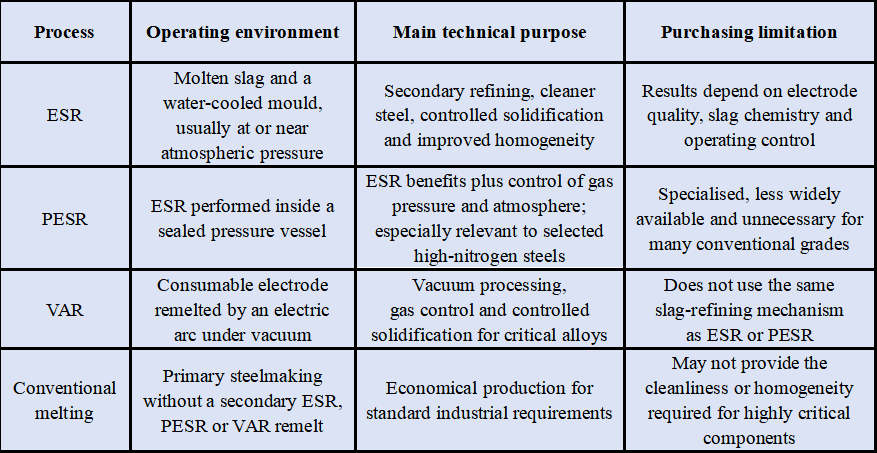
There is no universal ranking in which PESR is always first, ESR second and conventional steel last.
A well-specified conventional steel can be entirely suitable for a standard machine component. An ESR grade may be the practical choice for demanding extrusion tooling. PESR becomes meaningful when pressure or atmosphere control addresses a real metallurgical requirement.
How Does PESR Work?
The process can be understood in six stages.
1. A consumable electrode is prepared
The starting alloy is cast or forged into an electrode. Its chemistry must already be under control. PESR is a refining and remelting process, not a way to repair an arbitrary or incorrect alloy composition.
2. The electrode and mould are enclosed
The electrode, selected slag system and water-cooled mould operate within a sealed pressure vessel. This enclosure allows the furnace atmosphere to be set according to the metallurgical objective.
3. Pressure and gas composition are established
When producing a high-nitrogen steel, nitrogen pressure helps the molten metal dissolve and retain more nitrogen than would normally be practical at atmospheric pressure. Research on pressurised ESR identifies control of gas pressure and composition as a central feature of the process.
4. Electric current heats the slag
The conductive slag acts as the resistance-heating medium. Heat generated in the slag melts the lower end of the electrode.
5. Metal droplets pass through the slag
Molten droplets travel through the slag before joining the metal pool. Metal–slag reactions can help reduce or redistribute certain impurities and non-metallic inclusions. The result depends on the starting electrode, slag chemistry, melting rate and overall process control.
6. A new ingot solidifies under controlled conditions
The water-cooled mould removes heat while the ingot forms progressively. When the process is properly controlled, the resulting solidification pattern can support a compact structure, improved chemical homogeneity and lower segregation risk. Research also shows that pressure can influence nitrogen content and solidification behaviour.
Why Is the ESR Furnace Placed Under Pressure?
The clearest reason is nitrogen control.
At atmospheric pressure, there is a practical limit to how much nitrogen molten steel can dissolve and retain. Increasing nitrogen pressure changes the equilibrium, allowing specially designed alloys to reach nitrogen levels that would otherwise be difficult to produce.
In an appropriate steel composition, nitrogen can affect:
• strength;
• corrosion behaviour;
• phase balance;
• hardening response;
• residual ferrite;
• microstructural stability.
A Montanuniversität Leoben study describes industrial PESR routes for high-nitrogen steel and reports that controlled nitrogen transport through the slag can produce a highly homogeneous nitrogen distribution in the ingot.
Pressure may also influence heat transfer, cooling rate and metal-pool shape. These variables have to be managed together. More pressure does not automatically mean a better ingot.
What Happens Inside the Slag?
The slag performs several jobs at once.
First, it conducts electrical current and generates the heat needed to melt the electrode. Second, it creates a controlled path through which the metal droplets travel. Third, its chemistry influences reactions with the molten metal.
This is why two heats described simply as “PESR” may not be identical in quality. The label alone does not reveal:
• the starting electrode quality;
• the slag composition;
• the melting rate;
• the pressure programme;
• the cooling conditions;
• the ingot size;
• the forging reduction applied after remelting.
For procurement purposes, PESR should therefore be treated as one part of the manufacturing specification, not as a substitute for measurable acceptance criteria.
What Benefits Can PESR Deliver?
Controlled nitrogen content
The pressure-controlled atmosphere makes PESR particularly valuable for selected high-nitrogen steels. This is the capability that most clearly separates it from ordinary ESR.
Improved cleanliness
Like ESR, PESR can reduce risks associated with certain non-metallic inclusions when the electrode, slag and melting programme are properly controlled. Cleaner steel may support fatigue reliability, polishability and resistance to premature cracking in suitable applications.
Better compositional homogeneity
Droplet refining and progressive solidification can help create a more uniform alloy distribution. This matters when local variations in chemistry or microstructure could affect machining, polishing, hardening or service life.
More controlled solidification
The ingot forms progressively in a water-cooled mould. Appropriate control of the metal pool and cooling conditions can reduce segregation and produce a more predictable internal structure.
Consistency in demanding specialty steels
High-cleanliness, corrosion-resistant mould steels and other specialised alloys may benefit when polishing behaviour, fatigue performance, toughness or corrosion resistance depends on a uniform internal structure. Industrial material guidance identifies remelting as an important route for some high-purity corrosion-resistant tool steels.
What PESR Does Not Guarantee
PESR is a manufacturing process, not a promise of perfection.
It does not automatically guarantee:
• zero inclusions;
• zero segregation;
• perfect polishability;
• longer tool life in every application;
• correct hardness;
• correct heat treatment;
• freedom from machining or heat-treatment cracks;
• immunity to corrosion;
• that a supplied bar was genuinely pressure-remelted.
The finished component still depends on forging reduction, heat treatment, grain flow, machining practice, surface condition, geometry and service loading.
A purchase order should define the properties and inspection results that matter. The words “PESR quality” are not enough on their own.
Is PESR Steel Always Better Than ESR Steel?
No. PESR is the better choice only when its pressure-controlled atmosphere solves a specific metallurgical problem.
For many hot-work tool steels, a qualified ESR route may already provide the required cleanliness, homogeneity and toughness. For ordinary engineering steel stock, conventional melting may be completely appropriate. PESR is most compelling when the steel has been designed around elevated nitrogen or another requirement that benefits directly from pressure control.
The correct sequence is:
1. identify the component and its failure mode;
2. select the steel grade;
3. define the heat treatment and required properties;
4. decide whether secondary remelting is needed;
5. choose ESR, PESR or VAR only when the alloy and specification support that route.
How Can a Buyer Confirm the PESR Route?
Request traceable documentation that connects the actual material to its manufacturing history.
The documentation should identify, where applicable:
• steel grade and standard;
• heat number;
• product form and dimensions;
• primary melting and remelting route;
• delivery or heat-treatment condition;
• mechanical test results;
• ultrasonic test results;
• cleanliness or inclusion rating;
• third-party inspection status.
If PESR is commercially or technically important, the pressure-remelting route should appear in the steelmaker’s traceable records or agreed certification. A stock label or sales description is not sufficient evidence.
Frequently Asked Questions
What is the Pressure Electroslag Remelting Process (PESR)?
PESR is electroslag remelting carried out in a sealed pressure vessel. It combines slag refining and controlled ingot solidification with control over gas pressure and atmosphere. It is especially useful for selected high-nitrogen steels.
What is the main difference between PESR and ESR?
Both use a consumable electrode, molten slag and a water-cooled mould. PESR adds a sealed pressure vessel so that pressure and gas composition can be controlled during remelting.
Why is nitrogen used in PESR?
Elevated nitrogen pressure allows selected steel compositions to dissolve and retain more nitrogen than would normally be practical at atmospheric pressure.
Does PESR remove every inclusion?
No. PESR can improve steel cleanliness, but no industrial remelting route guarantees a completely inclusion-free ingot. Inspection methods and acceptance limits must still be specified.
Does PESR replace heat treatment?
No. The melting route creates the starting material condition; heat treatment develops the required properties later. Incorrect hardening, tempering, ageing or stress relief cannot be corrected simply because the steel was PESR-produced.
Which materials may justify PESR?
Selected high-nitrogen stainless steels and high-cleanliness corrosion-resistant mould steels are among the clearest candidates. The application, steelmaker route and customer specification must be checked before ordering.
Contact us: info@dgvimsteel.com
Whatsapp: +86 13423121371


Comments