
Cr-Mo Steel +QT Heat Treatment: Quenching, Tempering, Strength, and Section-Size Effects

Yesterday, we established that AISI 4130, 25CrMo4, 1.7218, SCM430, and 30CrMo are not defined by chemistry alone. The delivery condition is equally important. This is where +QT, or quenched and tempered, becomes the center of the discussion.
A buyer may receive two bars carrying the same grade name and still see very different hardness, tensile strength, machinability, and distortion after processing if the heat-treatment route is different. The reason is straightforward: heat treatment changes the internal structure, not just the surface number recorded by a hardness tester.
The short answer is:
Cr-Mo steel is quenched to create a hard martensitic structure and then tempered at a higher temperature to release stress and recover toughness. The final balance depends on temperature, cooling rate, section size, and the actual heat-treatment record.
What +QT means in practical terms
The +QT route has four basic steps:
1. Heat the steel into the austenitizing range.
2. Hold long enough to obtain a reasonably uniform austenitic structure.
3. Quench rapidly enough to form martensite.
4. Reheat for high-temperature tempering, then cool under controlled conditions.
The as-quenched steel is not normally ready for service. It may have high hardness, but it also contains large internal stresses and has poor tolerance for impact or sudden loading. Tempering changes the structure into tempered martensite or tempered sorbite, where strength remains high while ductility and toughness become useful for engineering service.
That is why a quotation that says “quenched only” should not be treated as a +QT quotation. Quenching and tempering are a pair. Omitting the temper, or using a low-temperature temper when the design expects high-temperature tempering, can create a serious mismatch between the drawing and the delivered material.
Typical temperature windows
The following ranges are practical reference windows for 4130-type Cr-Mo steels and 25CrMo4-type products. They are not a substitute for the approved heat-treatment procedure.

The actual setpoints depend on the grade, diameter, furnace accuracy, loading pattern, holding time, agitation, quench medium, and required properties. A supplier may use oil quenching for a common round-bar size, while a different section or production route may require another validated cooling practice.
The important procurement question is not “what temperature did you find online?” It is “what approved procedure was used for this heat and this diameter, and what properties were measured afterward?”
Why high-temperature tempering is so valuable
A high-temperature temper is not simply a way to lower hardness. It is a way to make the material more predictable under load.
During tempering, carbon redistributes and transition carbides or cementite develop from the supersaturated martensitic structure. Internal stresses fall, dimensional stability improves, and the material gains more useful plasticity. As tempering temperature rises, hardness and tensile strength generally decrease, while toughness and ductility improve.
This creates a design lever:
• A lower tempering temperature retains more hardness and strength.
• A higher tempering temperature usually provides better toughness and stress relief.
• The correct point depends on the load spectrum, not on a “maximum hardness” target alone.
For shafts and gears subjected to repeated impact, a slightly lower strength level with better toughness may deliver longer service than the hardest condition. For a lightly loaded fixture, the customer may prioritize machinability or dimensional stability instead.
Tempered martensite versus the as-quenched structure
The difference is easiest to explain with a workshop example. Imagine a small test piece quenched from the austenitizing range. It may feel impressively hard, but that hardness is accompanied by a stressed structure that can crack at a notch or sharp corner.
After high-temperature tempering, the same steel no longer behaves like a piece of glass. Its hardness is lower, but the structure can absorb more energy before cracking. In a properly controlled Cr-Mo product, the strength–toughness combination is the reason the material can serve in rotating parts, brackets, pressure-related components, and high-load fasteners.
This does not mean that every +QT batch has the same microstructure. Furnace practice, section size, prior forging or rolling condition, and cooling uniformity all influence the result. A microstructure requirement, when important, should be written into the technical specification and verified by the supplier’s quality system.
Section size changes the result
A small-diameter bar cools faster through its entire cross-section. A large-diameter bar cools quickly near the surface but more slowly at the core. Since the transformation path depends on cooling rate, the center of a large bar may not reach the same hardness or strength as the surface.
For a 25CrMo4 / 1.7218 type product in +QT condition, a typical tensile-strength pattern may look like this:
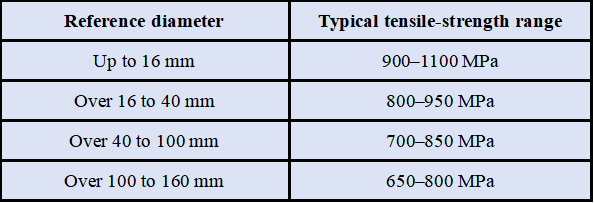
These ranges are representative engineering references, not universal guarantees. The applicable standard, product form, and actual test location control acceptance. A large shaft that passes a surface hardness check may still have a weaker core than the design assumes.
For diameters above 100 mm, buyers should request:
• the size range used for the mechanical test;
• whether the test coupon came from the center, mid-radius, or surface;
• heat-treatment records for the same or a comparable diameter;
• hardness mapping or additional testing where the design requires it;
• evidence that the supplier understands the required core properties.
How +A, +N, and +QT compare

Annealed material can be the best starting point when a customer plans extensive machining and a later final heat treatment. Normalized material may be suitable when the part does not need the maximum strength of +QT. +QT is normally selected when the component will carry significant load and the final mechanical properties must be demonstrated.
The wrong condition can create costs in both directions. Ordering +QT when most of the material will be removed may increase machining time and tool wear. Ordering +A when the finished part needs a specified yield strength can leave the design under-strength.
Machining and dimensional stability
Heat treatment can move a part. The amount depends on geometry, stock removal, residual stress, heating uniformity, quenching severity, and support during processing.
A practical sequence for a machined shaft or gear blank is often:
1. Receive annealed or normalized stock.
2. Rough machine with enough allowance.
3. Quench and temper.
4. Allow the material to stabilize.
5. Finish machine or grind critical surfaces.
If the customer buys already-quenched-and-tempered bar, the supplier should confirm the dimensional tolerance and surface condition. Hot-rolled black bar, peeled bar, turned bar, and ground bar do not carry the same machining allowance. Price comparisons should include the amount of material the buyer must remove before the final dimension is reached.
What should appear on the MTC?
For a +QT Cr-Mo product, a useful certificate should normally identify:
• grade and governing standard;
• heat number;
• product size and form;
• chemical analysis;
• delivery condition;
• tensile test results;
• yield strength and elongation where required;
• impact test results when specified;
• hardness and test method;
• heat-treatment details or reference;
• inspection standard and certificate level.
A generic certificate copied from a previous order is not an adequate substitute for a certificate tied to the actual heat and delivery lot.
Practical heat-treatment questions for a quotation
Before approving a +QT offer, ask whether the quoted properties were measured on the same diameter, the same heat, and the same delivery condition as the material being sold. Also ask whether the test coupon represents the center or the surface of the bar. These questions are especially useful for stockholders, because a standard certificate may cover a heat while the customer’s cut length has a different section size or machining allowance. Clear answers at this stage prevent a later argument over whether the material “passed” only on paper.
+QT is the stage where Cr-Mo steel becomes a practical high-strength engineering material. Quenching creates the hard structure; high-temperature tempering controls the final balance between strength, hardness, toughness, and dimensional stability.
The larger the section, the more carefully the buyer must consider core properties. A surface hardness reading alone cannot prove that a large-diameter bar meets the center strength required by a shaft, pin, gear, or pressure-related component.
Contact us: info@dgvimsteel.com
Whatsapp: +86 13423121371


Comments