
How to Buy Cr-Mo Steel: 4130 and 25CrMo4 Applications, Welding, Inspection, and RFQ Checklist

Cr-Mo low-alloy steel is often described as a “general-purpose high-strength alloy steel.” That description is useful, but it can also create bad assumptions. 4130 is weldable, but it is not weld-and-forget. 25CrMo4 is strong, but a large-diameter bar may not have the same core properties as a small bar. A certificate may show the right chemistry, yet still fail to prove that the delivery condition matches the drawing.
A reliable decision therefore connects four things:
service load + product size + delivery condition + verified documentation
Where Cr-Mo steel is commonly used
Aircraft and lightweight structures
AISI 4130 became well known in aircraft structures because it offers a useful combination of strength, toughness, weight efficiency, and weldability. It can be used for structural tubes, engine mounts, brackets, landing-gear-related components, and other parts where repeated vibration and alternating loads matter.
The attraction is not that 4130 is the strongest steel available. The attraction is that a designer can obtain a strong, relatively light structure without moving immediately to a much more expensive alloy or a difficult-to-weld high-carbon grade.
Automotive and racing structures
Racing frames, roll cages, suspension parts, chassis members, and tubular brackets often require a material that can absorb impact rather than fail without warning. 4130 is frequently considered because its carbon level is lower than 4140 and its weldability is more practical when the procedure is controlled.
The tubing specification still matters. Wall thickness, cold-work history, heat treatment, weld sequence, joint design, and post-weld inspection can influence the result more than the brand name printed on the bundle.
Oil and gas equipment
Cr-Mo steel can be used for high-load mechanical parts, valve and pump components, drilling connections, alloy tubing, and other equipment exposed to pressure and repeated mechanical loads.
In oilfield service, however, “Cr-Mo” is not a complete corrosion specification. Sour service, hydrogen exposure, chloride contamination, and pressure cycling may require separate material rules and testing. A 4130 product intended for a dry mechanical component should not automatically be approved for a sour environment.
General machinery
Shafts, gears, crankshafts, pins, high-strength bolts, and other transmission parts are common applications for 25CrMo4, 1.7218, 30CrMo, and related grades. The +QT route provides a useful combination of tensile strength and toughness, while local surface hardening can be added when wear is concentrated at a bearing journal or contact zone.
The final choice should follow the stress calculation. Cr-Mo steel is not a substitute for a dedicated tool steel when the dominant failure mode is hot wear, cold-work chipping, or die erosion.
Energy and pressure-related components
Rotors, high-load brackets, and selected high-temperature or pressure-related components may use Cr-Mo alloys when the temperature range and design standard are compatible.
The word “high-temperature” needs care. Cr-Mo steel can retain useful strength above room temperature, but it is not interchangeable with heat-resistant stainless steel or a nickel-based superalloy. The design temperature, exposure time, oxidation environment, and required creep performance must be considered separately.
Welding 4130: why “weldable” still needs a procedure
4130 is generally easier to weld than 4140 because of its lower carbon level, but the heat-affected zone can still become hard, soften locally, or develop cracking risk if the process is poorly controlled.
A typical procedure may involve:
• preheating, often around 150–200°C as a starting reference;
• low-hydrogen consumables;
• dry storage and correct electrode handling;
• controlled heat input and interpass temperature;
• gradual cooling rather than a sudden cold quench;
• post-weld heat treatment where thickness, restraint, and service conditions require it.
The exact procedure belongs to the welding engineer and should be supported by a qualification record. A temperature copied from a catalog should not replace a welding procedure specification.
For tubular structures, a common manufacturing route is to weld annealed or normalized material first and apply the final whole-part heat treatment afterward, if the geometry and design permit. That route can make fabrication easier and reduce the mismatch between weld-zone properties and base-metal properties. It is not automatically suitable for every assembly; distortion, access, joint design, and dimensional tolerances must be checked.
Machining and surface hardening
The machining route should be chosen together with the final heat-treatment plan.
A practical sequence for a shaft, gear blank, or pin may be:
1. rough machine in an annealed or normalized condition;
2. leave controlled stock for heat-treatment movement;
3. quench and temper;
4. allow the part to stabilize;
5. finish machine, turn, or grind critical features.
If the customer orders fully +QT bar and then removes a large amount of stock, tool life and dimensional control may suffer. On the other hand, machining too close to the final dimension before quenching can leave insufficient allowance for distortion.
For wear zones, engineers may evaluate induction hardening or nitriding after the core has been strengthened by +QT. These methods can improve surface wear resistance while preserving a tougher core. The required case depth, hardness profile, transition zone, and distortion limit should be specified rather than left to a generic “surface hardened” note.
Product form and surface condition affect the quote
A hot-rolled black round bar, peeled bar, turned bar, and ground bar can all carry the same grade name but have different commercial and machining value.
Ask the supplier to state:
• hot-rolled or forged origin;
• peeled, turned, ground, or black surface;
• diameter tolerance and roundness;
• straightness;
• mill length or fixed cut length;
• cutting tolerance;
• machining allowance;
• end condition after saw cutting;
• bundling and identification method.
The cheapest price is not always the lowest material cost. A bar that requires heavy peeling or long preparation may become more expensive after machining than a higher-priced bar supplied closer to the requested condition.
Inspection and traceability
For a safety-related Cr-Mo component, documentation should follow the material from melting to delivery.
At minimum, a buyer should expect the certificate to connect the product to a heat number and identify the governing standard. Depending on the project, additional inspection may include:
• tensile testing;
• yield strength and elongation;
• impact testing;
• hardness testing;
• ultrasonic testing;
• dimensional inspection;
• surface inspection;
• heat-treatment record review.
EN 10204 3.1 is a common certificate level for industrial purchasing. Some projects require 3.2 or an additional independent inspection. The correct level should be agreed before production, not requested after the material has been cut and packed.
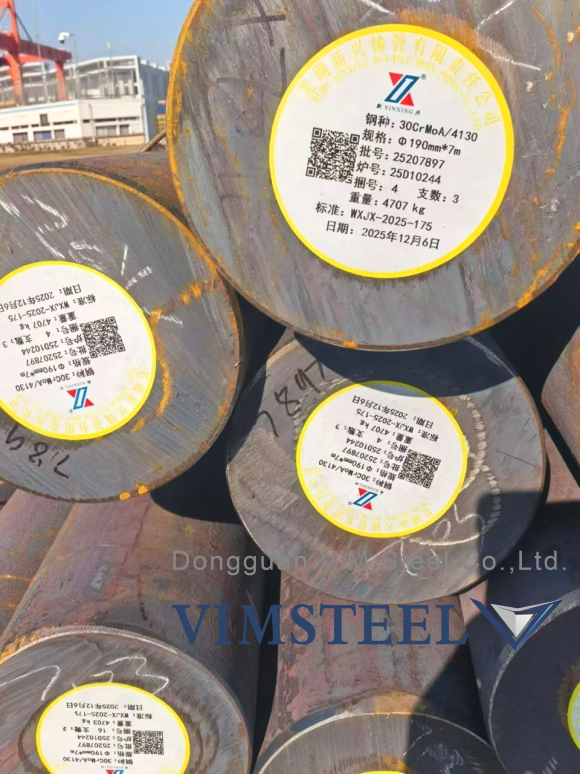
If a stockholder cuts one bar into several pieces, the heat number and certificate reference should remain visible on each piece or on a controlled cutting record. This is a small administrative step that becomes extremely valuable when a customer later asks which heat supplied a particular machined component.
When Cr-Mo steel is the wrong choice
Good material selection includes knowing when to stop using a familiar grade.
Cr-Mo steel is not automatically a replacement for:
• 4140 or 42CrMo4 when a design needs higher carbon, hardness, or wear resistance in a large solid part;
• H13 / 1.2344 when the component is a hot-work die exposed to thermal fatigue and hot wear;
• 1.4542 / 17-4PH when corrosion resistance and precipitation-hardening strength are both required;
• nickel alloys when the service temperature, oxidation, or chemical environment exceeds the capability of low-alloy steel.
These are not automatic substitutions in either direction. The correct decision depends on the actual failure mode, not the popularity of the grade.
A buyer-ready Cr-Mo steel RFQ checklist
A complete inquiry should include:
• preferred grade and standard: AISI 4130, 25CrMo4, 1.7218, SCM430, 30CrMo, or another approved option;
• product form: round bar, tube, forging, plate, or finished component;
• diameter, section, length, and quantity;
• delivery condition: +A, +N, or +QT;
• target tensile strength, yield strength, elongation, impact, and hardness;
• surface condition and dimensional tolerance;
• straightness, roundness, and cutting requirements;
• heat-treatment procedure or required records;
• MTC level, such as EN 10204 3.1 or 3.2;
• ultrasonic or other non-destructive testing;
• heat-number traceability after cutting;
• welding, low-temperature, sour-service, or fatigue requirements;
• packaging, markings, and delivery schedule;
• whether an equivalent grade may be offered and what approval documents are required.
FAQ: common purchasing questions
Is 4130 the same as 25CrMo4?
They are close Cr-Mo grades and may be considered for substitution in some general mechanical applications. They are not automatically identical in every standard, product form, size range, or delivery condition. Approval should be based on the drawing and the actual certificate.
Can 4130 be welded after +QT?
It can be welded in some designs, but the procedure needs control. Preheat, low-hydrogen practice, heat input, cooling, and possible post-weld heat treatment should be evaluated by a qualified welding engineer.
Is a surface hardness test enough for a large bar?
No. Surface hardness does not prove that the core meets the required strength. Large sections need size-specific mechanical data and, where appropriate, hardness mapping or additional testing.
Is Cr-Mo steel corrosion-resistant?
It has useful alloy-steel performance but should not be treated as stainless steel. Marine, chloride, sour-service, or strong chemical environments may require stainless steel, duplex stainless, precipitation-hardening stainless, or nickel alloys.
Conclusion
Cr-Mo low-alloy steel remains valuable because it solves a common engineering problem: how to obtain high useful strength without giving up all toughness, weldability, machinability, or cost control.
The best purchase is not simply the cheapest 4130 or the hardest 25CrMo4. It is the delivery that matches the required standard, section size, heat-treatment condition, inspection level, and service environment.
If you are sourcing AISI 4130, 25CrMo4, 1.7218, 30CrMo, or a related Cr-Mo round bar, send the supplier the diameter, length, condition, performance targets, surface requirement, testing level, and intended application together. A technically complete RFQ gives you a more comparable quotation and greatly reduces the risk of receiving the right chemistry in the wrong condition.
Contact us: info@dgvimsteel.com
Whatsapp: +86 13423121371


Comments