
S355JR vs S355J0 vs S355J2 vs S355K2 Round Bar: Which Grade Should You Buy?

A buyer recently sent us a short inquiry: “Need S355 round bar.”
That tells us the material family, but it is not yet enough for an accurate quotation. Which impact grade is required—S355JR, S355J0, S355J2 or S355K2? Does the drawing require +AR or +N ? What diameter, length, surface condition and tolerance are needed? Will the bars be supplied in mill lengths or cut to size? Is an EN 10204 3.1 certificate sufficient, or does the project require additional testing or third-party inspection?
These details affect availability, processing, price and lead time. They also determine whether the supplied round bar matches the drawing.
This guide is written for stockholders, machining companies, equipment manufacturers and distributors preparing a real S355 round bar purchase.
Which S355 Round Bar Grade should you buy?
Choose the grade according to the required impact-test temperature and energy, not by assuming that one grade is simply “stronger” than the others:

JR, J0 and J2 move the 27 J requirement to progressively lower temperatures. K2 raises the minimum impact energy to 40 J at −20°C. S355K2 is not a “−40°C grade.”
For a useful quotation, send the full grade, governing standard, diameter, length, quantity, delivery condition, surface condition, dimensional tolerance, impact requirement, certificate and inspection scope.
What does S355 mean for Round Bar?
S355 is a structural-steel strength family. The letter S identifies structural steel, while 355 represents the nominal minimum yield-strength class for the relevant lower size range. It should not be interpreted as a guarantee that every diameter has the same 355 MPa minimum yield strength.
Mechanical requirements can change with product dimension. The applicable table in the governing standard, together with the actual mill certificate, controls acceptance. EN 10025-2 covers technical delivery conditions for non-alloy structural-steel flat and long products, including relevant bar products.
Ovako describes S355 as a structural micro-alloyed grade used for a wide range of applications and lists related JR, J2 and K2 variants with specified impact requirements. Its S355J2 data also position the grade for mechanical engineering applications and emphasize weldability and variant-specific properties.
For buyers, the practical rule is simple: never approve a round bar only because the marking begins with S355. Verify the complete suffix, diameter range, condition and certificate.
S355JR vs S355J0 vs S355J2 vs S355K2
S355JR Round Bar
S355JR is commonly considered for general-purpose structural and mechanical parts operating in moderate temperatures. The JR quality is associated with a minimum Charpy V impact energy of 27 J at +20°C.
It can be a practical option for pins, spacers, supports, general shafts, machine-frame components and welded parts where the design does not require sub-zero impact verification.
S355JR should not be substituted for J0, J2 or K2 simply because it is available sooner. If the drawing specifies a colder impact-test temperature, the quality suffix is a functional requirement.
S355J0 Round Bar
S355J0 keeps the typical 27 J minimum impact requirement but moves the test temperature to 0°C.
This grade may be selected when the service or project specification requires impact verification below normal room temperature, but not as low as the J2 test condition. Availability in the required round bar diameter should be confirmed before promising a delivery date.
S355J2 Round Bar
S355J2 is one of the more commercially relevant options for machinery and structural round bar where impact toughness at −20°C is required. Ovako describes S355J2 as a micro-alloyed structural steel suitable for mechanical engineering applications and notes good weldability for its listed variants.
Typical uses may include machined pins, shafts, connecting parts, supports, tie components and other engineering parts, subject to the design loads and product condition.
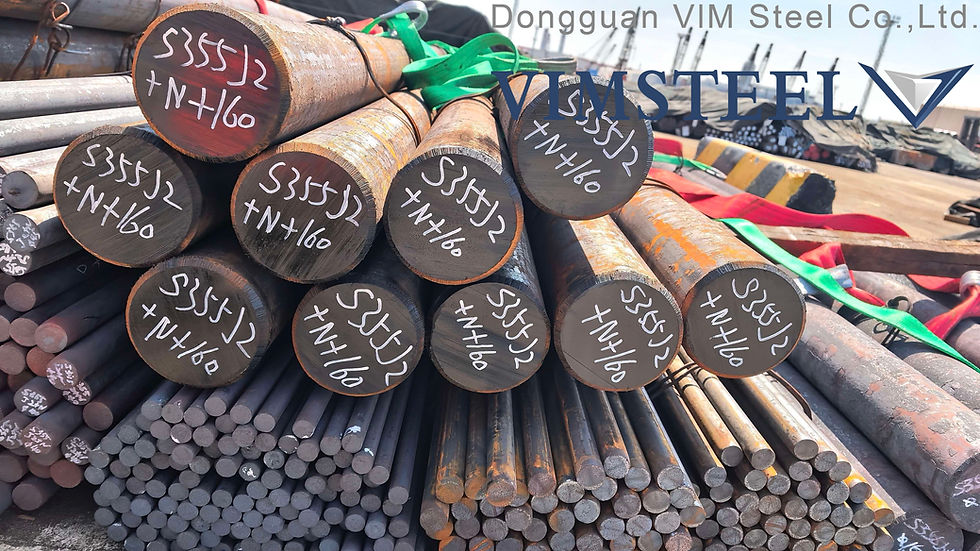
S355J2 is not automatically the same as S355J2+N. The J2 suffix identifies impact quality; +N identifies normalized or normalized-rolled delivery.
S355K2 Round Bar
S355K2 is specified when the design requires a higher impact-energy level at −20°C—typically 40 J rather than the 27 J associated with J2.
It should not be described as a −40°C grade. If the design temperature is −40°C or lower, the responsible engineer should review an appropriate fine-grain or low-temperature structural-steel grade instead of assuming that K2 solves the requirement.
How to read S355J2+N Round Bar
The designation contains several separate purchasing instructions:
S: structural steel;
355: nominal yield-strength class, subject to product dimension;
J2: impact-quality requirement, typically 27 J at −20°C;
+N: normalized or normalized-rolled delivery condition.
A quotation for S355J2 round bar in an unspecified or as-rolled condition is not automatically equivalent to an inquiry for S355J2+N.
If +N is mandatory, place it on the RFQ, purchase order, certificate requirement and bar marking instruction. It may affect mill availability, minimum quantity and lead time.
+AR, +N and S355M: Do not mix the delivery routes
+AR: As Rolled
+AR identifies the as-rolled delivery condition. It may be commercially attractive for general round bar applications, but the buyer still needs to confirm mechanical properties, diameter range and suitability for subsequent fabrication.
+N: Normalized or Normalized Rolled
+N identifies normalized or normalized-rolled delivery. It is often requested when the drawing or project standard requires a more explicitly controlled delivery condition.
Do not assume that a supplier can normalize any available S355JR or S355J2 bar after purchase and automatically recreate a certified mill-grade product. If heat treatment is performed outside the original mill route, the final product specification, testing and recertification requirements must be agreed.
S355M and S355ML
S355M and S355ML belong to thermomechanically rolled fine-grain structural-steel routes under EN 10025-4. They are not created by adding +M casually to an S355JR or S355J2 inquiry.
Ask for the exact grade, standard, product form, diameter range and original mill documentation before treating a thermomechanically rolled option as an alternative.
Which Round Bar surface condition should you specify?
“S355 round bar” does not describe the surface.
Hot-Rolled Black Bar
Hot-rolled black bar is often the most economical starting material. Mill scale and normal hot-rolled surface variation mean the buyer should allow enough machining stock for the finished diameter.
It is suitable when the customer will rough-machine the complete surface or when the as-rolled finish is acceptable.
Peeled or Turned Round Bar
Peeling or turning removes the hot-rolled surface and provides a cleaner, more consistent starting diameter for machining. It can reduce rough-machining time and reveal surface imperfections that would otherwise remain below scale.
The buyer must still specify the actual diameter tolerance, straightness and permissible surface defects. “Peeled” alone is not a complete tolerance requirement.
Ground or Precision-Finished Bar
Ground bar may be relevant when the component needs a tighter diameter, better surface finish or reduced machining. Availability depends on grade, diameter and quantity.
A precision surface increases processing cost, so it should be ordered only when it creates value in the finished part.
Diameter, Ovality and Straightness Matter
EN 10060 specifies nominal dimensions and tolerances on dimensions and shape for hot-rolled round steel bars. Its scope includes diameter, shape-related and dimensional requirements for this product form.
A commercial inquiry should state:
nominal diameter;
permitted diameter tolerance;
ovality requirement;
straightness requirement;
mill length or fixed cut length;length tolerance;
surface condition;
end condition after sawing;
machining allowance.
Do not assume that ordinary hot-rolled tolerance is suitable for a long machined shaft. A bar can meet the material grade and still create excessive machining time or runout problems if straightness and allowance were never specified.
For critical rotating parts, the designer may need a different product condition or a dedicated shaft-steel specification rather than ordinary structural round bar.
What changes the price of S355 Round Bar?
A useful S355 round bar price request needs more than a diameter. The following points materially change the quotation:
1. Exact grade: JR, J0, J2, K2, J2+N or another specified condition.
2. Governing standard and revision.
3. Round bar diameter and required tolerance.
4. Mill length, random length or fixed cut length.
5. Total quantity and number of individual cut pieces.
6. Hot-rolled, peeled, turned or ground surface.
7. Straightness and surface-quality requirements.
8. Impact-test temperature, energy and test direction.
9. EN 10204 3.1 or 3.2 inspection document.
0. Ultrasonic testing, magnetic-particle testing or other NDT.
1. Third-party inspection and witness scope.
2. Saw cutting, marking, rust prevention and export packing.
3. Approved mill or country-of-origin restriction.
4. Incoterm, destination and required delivery date.
Compare quotations by included scope, not just price per tonne. One offer may include cutting, certificate transfer and export packing while another covers only full-length black bars.
S355 Round Bar vs Q355: Is substitution automatic?
The following cross-reference is often used for initial sourcing:

This is a purchasing clue, not an authorization to substitute. GB/T and EN standards can differ in chemical limits, impact-energy requirements, product dimensions, delivery conditions, sampling and inspection.
For any proposed alternative:
1. Identify both standards and revisions.
2. Confirm that both standards cover the requested round bar diameter.
3. Compare chemistry and carbon equivalent.
4. Compare dimension-dependent mechanical properties.
5. Compare impact energy, test temperature and test direction.
6. Compare delivery condition and dimensional tolerance.
7. Confirm certification and inspection.
8. Obtain written approval from the designer or end user.
Avoid writing only “S355 or equivalent” on a critical round bar order.
Typical uses of S355 Round Bar
Subject to engineering approval, S355 round bar may be considered for:
general machinery shafts and axles;
pins, tie rods and connecting components;
machined spacers, sleeves and supports;
equipment-frame connections;
lifting, mining and conveying equipment parts;
aluminum-extrusion-line supports and non-tooling components;
mold-handling equipment and non-working structural parts.
How stockholders should control S355 Round Bar
Stock records should distinguish:
full grade and standard;
diameter and length;
delivery condition;
impact quality;
surface condition;
heat number and original mill;
certificate type;
inspection status.
After sawing, each customer piece and remaining bar must retain a controlled link to the original heat number and certificate. Mixing S355JR, S355J2 and S355J2+N under one generic “S355” stock code creates avoidable risk.
Before shipment, verify that transferred markings, packing list and material certificate describe the same heat, grade, condition and dimensions.
How to Qualify an S355 Round Bar Supplier
Ask the supplier to confirm:
which S355 grades are available as round bar;
available diameters and mill lengths;
whether material is stock or new production;
hot-rolled, peeled, turned or ground condition;
applicable diameter and straightness tolerances;
original mill and country of origin;
heat-number traceability after cutting;
EN 10204 certificate availability;
impact-test values and test direction;
additional NDT capability;
third-party inspection arrangements;
cutting, marking, packing and delivery scope.
A statement such as “S355 available” is not enough. Request a technical offer and, where appropriate, a redacted sample certificate before ordering.
S355 Round Bar RFQ checklist
Include these points in the inquiry:
1. Full grade, such as S355J2+N.
2. Product standard and required revision.
3. Diameter and total quantity.
4. Mill length or fixed cut lengths.
5. Surface condition.6. Diameter, ovality and straightness tolerances.
7. Impact requirement and test direction.
8. Delivery condition.
9. EN 10204 certificate type.
10. UT, MPI or other inspection requirement.
11. Third-party witness or approval requirements.
12. Bar-end marking and heat-number transfer.
13. Rust prevention and export packing.
14. Delivery destination, Incoterm and required date.
15. Whether alternative grades are permitted.
Frequently Asked Questions
What is the main difference between S355JR, S355J0, S355J2 and S355K2 round bar?
The main distinction is the Charpy V impact requirement. JR, J0 and J2 typically require 27 J at +20°C, 0°C and −20°C respectively; K2 typically requires 40 J at −20°C.
Is S355J2 round bar the same as S355J2+N round bar?
No. J2 identifies the impact-quality level. +N additionally specifies normalized or normalized-rolled delivery.
Is S355K2 a −40°C grade?
No. S355K2 normally refers to a 40 J requirement at −20°C. A −40°C service or test requirement needs a separate material review.
Does every diameter of S355 round bar have a 355 MPa minimum yield strength?
Not necessarily. Minimum mechanical properties can change with product dimension. Check the applicable standard table and the actual mill certificate.
What tolerance applies to hot-rolled S355 round bar?
EN 10060 is commonly used for dimensions and shape tolerances of hot-rolled round steel bars. The RFQ should still state the required diameter, ovality, straightness and length tolerance.
Can Q355D round bar replace S355J2 round bar?
Not automatically. The standards, chemistry, mechanical-property tables, impact requirements and inspection rules must be compared, followed by written approval.
Conclusion: Buy the Complete Round Bar Specification
The best S355 grade is not the one with the longest suffix. It is the grade whose impact requirement, delivery condition, diameter range and documentation match the component.
Use this purchasing sequence:
Confirm the standard → select JR, J0, J2 or K2 → specify the delivery condition → state diameter and
tolerance → define cutting and traceability → confirm inspection, certificate, packing, price and lead time.
That search intent may attract fewer visitors than a broad “what is S355” page, but it reaches buyers who are selecting a grade or preparing an RFQ.
Request an S355 Round Bar quotation
DONGGUAN VIM STEEL can discuss S355 round bar, Q355, 4140 / 42CrMo4 steels and nickel alloys based on a specific inquiry.
Send the complete grade, standard, diameter, lengths, quantity, surface condition, tolerance, impact requirement, certificate, inspection scope and destination. Actual stock, processing, material suitability and delivery time remain subject to technical.
Contact us: info@dgvimsteel.com
Whatsapp: +86 13423121371


Comments