
Can Stainless Steel Be Quenched and Tempered (QT)? 304, 316, 430, 1.4529 and 1.4125 Guide

Updated: Sep 3
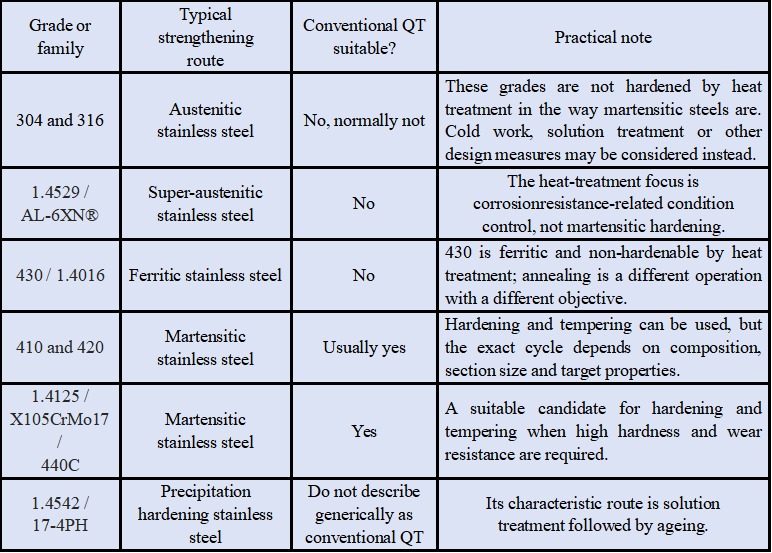
Some stainless steels can be quenched and tempered, but many cannot. Martensitic grades—such as 410, 420 and 1.4125 / X105CrMo17—can be hardened and tempered to balance hardness, strength and toughness. Austenitic grades such as 304, 316 and 1.4529, plus ferritic 430, do not gain their useful strength through conventional quench-and-temper (QT) treatment.
What Does Quench and Temper (QT) Mean?
In conventional steel heat treatment, quench and temper combines two linked operations:
Quenching heats the steel to its specified austenitising range and then cools it at a controlled rate. For hardenable steels, this creates a hard microstructure, commonly martensite.
Tempering reheats the quenched steel to a selected temperature. This reduces brittleness and residual stress while tuning the final balance of hardness, strength, toughness and dimensional stability.
Quenching alone can create a part that is very hard but too brittle for service. Tempering is what makes that hard state usable in many engineering components.
In strict technical communication, however, not every “hardening plus tempering” cycle should be called QT. In many specifications, quench and temper refers specifically to quenching followed by high-temperature tempering. Martensitic stainless steels may also use low- or intermediate-temperature tempering to retain high hardness. The purchase order, drawing and heat-treatment specification should therefore define the required condition rather than relying on the abbreviation “QT” alone.
Can All Stainless Steel Be Quenched and Tempered?
No. The key question is not whether the material is “stainless steel,” but whether its microstructure and chemistry allow it to transform into a hard martensitic structure during the specified cooling cycle.
Why 304 and 316 Are Not QT Grades?
Grades 304 and 316 are austenitic stainless steels. They can be heat treated for purposes such as solution annealing, stress relief or post-fabrication condition control. But they are not normally hardened by a conventional quench-andtemper route because that route does not deliver the martensitic transformation used to harden martensitic stainless steel.
This distinction matters in purchasing and design. A request for “304 QT” or “316 QT” is technically ambiguous and can lead to the wrong manufacturing route. If the real requirement is higher strength, surface hardness, galling resistance or wear resistance, the engineering team should instead assess cold-work strengthening, a different stainless family, a surface treatment or a revised component design.
Why 430 Is Not a Quench-Hardenable Stainless Steel?
Grade 430 / 1.4016 is ferritic stainless steel. It offers useful corrosion resistance, formability and surface finish for many applications, but it is not hardened by heat treatment in the way a martensitic grade is. Annealing can be specified where appropriate, yet annealing should not be confused with QT.
For this reason, 430 is generally not the right starting point when the part requires high through-hardness, cuttingedge retention or high wear resistance.
Can 1.4529 Be Quenched and Tempered?
No—not as a conventional martensitic QT treatment.
1.4529 / AL-6XN® is a super-austenitic stainless steel intended for demanding corrosion environments.
DONGGUAN VIM STEEL identifies 1.4529 as a super-austenitic grade with high resistance to pitting and crevice corrosion, and its material guidance addresses heat treatment after hot forming in the context of maintaining corrosion resistance.
Rapid cooling may be part of a solution-annealing or post-hot-forming route for 1.4529, but this is not the same as quenching a martensitic stainless steel to create a hard martensitic structure. Calling this process “QT” can cause a serious mismatch between the material’s intended performance and the requested heat treatment.
Use 1.4529 when corrosion resistance is the core requirement, not when maximum quench hardness is the main goal.
Can 1.4125 Be Quenched and Tempered?
Yes. Grade 1.4125 / X105CrMo17, often associated with 440C, is a high-carbon martensitic stainless steel. It is commonly selected where high hardness, wear resistance and useful corrosion resistance are all needed—for example, in cutting tools, high-quality blades, bearing components and selected surgical instruments.
DONGGUAN VIM STEEL’s grade page describes a hardening route followed by immediate tempering, while a Dörrenberg material data sheet identifies 1.4125 as a martensitic stainless steel with good hardenability and provides hardening and tempering guidance.
That does not mean one generic QT cycle fits every 1.4125 part. The final result will depend on:
the actual chemical composition and supply condition;
section thickness and part geometry;
austenitising temperature and soak time;
cooling method;
tempering temperature and holding time;
target hardness, toughness, corrosion resistance and dimensional-stability requirements.
For high-hardness 1.4125 applications, a low-temperature tempering route may be deliberately selected. That is why buyers and designers should specify the desired final property—not simply write “QT”.
How Tempering Changes Hardness and Toughness
Tempering is the control point that turns a hard but potentially brittle quenched condition into a usable engineering condition.
As a general rule:
Lower tempering temperatures tend to preserve more hardness and wear resistance, while toughness and residual-stress management must be evaluated carefully.
Higher tempering temperatures generally improve toughness and stress relief, with a corresponding change in hardness and strength.
The wrong tempering range may produce an unsuitable balance of impact resistance, corrosion resistance, dimensional stability or hardness.
For 1.4125 specifically, supplier data sheets provide defined hardening, cooling and tempering guidance and identify tempering ranges that require careful control. Use those values as a starting point only; production settings should be validated against the applicable standard, part geometry, batch chemistry and acceptance criteria.
QT, Hardening + Tempering, and Age Hardening Are Not Interchangeable
A common source of confusion is using one label for very different stainless-steel heat-treatment routes.
Quench and temper / hardening plus tempering
This route is most relevant to martensitic stainless steels, including grades such as 410, 420 and 1.4125. Its purpose is to develop an appropriate combination of hardness, strength and toughness.
Solution annealing
This route is commonly associated with austenitic stainless steels. It is used to restore a suitable microstructural condition and corrosion performance after certain fabrication or thermal exposures. It is not a substitute name for martensitic QT.
Solution treatment and ageing
This route applies to precipitation-hardening grades such as 1.4542 / 17-4PH. The material is supplied or processed in a solution-treated state and then strengthened by ageing; this differs from describing the grade as a conventional QT material.
How to Specify Stainless Steel Heat Treatment on a Drawing or PO
Instead of writing only “QT,” use a specification that can be tested and accepted:
Material: 1.4125 / X105CrMo17, or an approved equivalent standard
Supply condition: annealed, pre-hardened, or an agreed heat-treated condition
Heat treatment: harden and temper in accordance with the approved process specification
Acceptance criteria: chemical composition, final hardness range, dimensional tolerance, surface quality, and metallography or NDT where applicable
Documentation: material certificate, heat-treatment record, and agreed third-party inspection documentation
This approach helps avoid three common failures:
1. applying a QT requirement to a grade that cannot be QT-hardened;
2. receiving a part with the wrong hardness-toughness balance;
3. disputes caused by vague language such as “heat treated” or “fully hardened”.
Sourcing Special Stainless Steel from DONGGUAN VIM STEEL
For projects involving specialty stainless steels such as 1.4529, 1.4125 and 1.4539, begin the enquiry with the actual service condition—not just the grade name.
Useful information includes:
application: cutting tool, bearing, valve, pump shaft, offshore equipment, chemical-process equipment or mould component;
priority property: hardness, wear resistance, impact resistance, corrosion resistance or dimensional stability; finished dimensions and machining allowance;
required standard and permitted equivalents;
required documents: material certificate, inspection report or third-party testing scope.
Where third-party testing, material certificates or heat-treatment records are required, define the inspection standard, document format, cost responsibility and acceptance criteria in the quotation or contract. Verifiable requirements are more valuable to international buyers—and more credible to search engines and AI answer systems—than broad, untestable claims.
Frequently Asked Questions
Can stainless steel be quenched and tempered?
Some can. Martensitic stainless steels can generally be hardened and tempered. Austenitic and ferritic stainless steels do not normally use conventional QT to gain martensitic hardness.
Can 304 stainless steel be quenched to make it hard?
No. Grade 304 is austenitic and is not hardened by conventional heat treatment. If higher strength or hardness is required, evaluate cold work, surface treatment, an alternative grade or a design change.
Can 316 stainless steel be quenched and tempered?
Normally, no. Grade 316 is austenitic stainless steel and is not a conventional QT grade. Heat treatment may still be used for other purposes, but it should not be specified as martensitic quench and temper.
Can 430 stainless steel be heat hardened?
No. Grade 430 is ferritic stainless steel and cannot be hardened by heat treatment in the conventional sense.
Can 1.4529 be heat treated?
Yes, but not as a conventional QT-hardening grade. The relevant process is typically linked to corrosion-resistancerelated condition control, including solution-annealing considerations after hot forming.
Can 1.4125 be quenched and tempered?
Yes. 1.4125 is a hardenable martensitic stainless steel. The exact hardening and tempering cycle must be selected for the required final properties and verified for the actual component.
Which is better for high hardness: 1.4125 or 1.4529?
For high hardness and wear resistance, 1.4125 is usually the more relevant family because it is martensitic and hardenable. For severe corrosion resistance, especially resistance to pitting and crevice corrosion, 1.4529 is the more relevant super-austenitic grade. They serve different engineering priorities rather than representing a simple quality ranking.
Dongguan Vim Steel regularly exports specialty stainless steels such as 1.4542;1.4529 and 1.4125. Our materials can be verified through third-party inspection in accordance with the agreed standards and scope, giving you dependable, traceable quality ssurance and confidence in every mission.
Contact us: info@dgvimsteel.com
Whatsapp: +86 13423121371


Comments