
C45 Steel vs. 40Cr – How to Make the Right Choice?

If you work in mechanical engineering, you have almost certainly come across this decision before.
Shafts, gears, pins, sleeves, connectors, transmission parts – for so many common components, the material selection often narrows down to two familiar names: “C45 steel” and “40Cr”. On paper, they look quite similar.
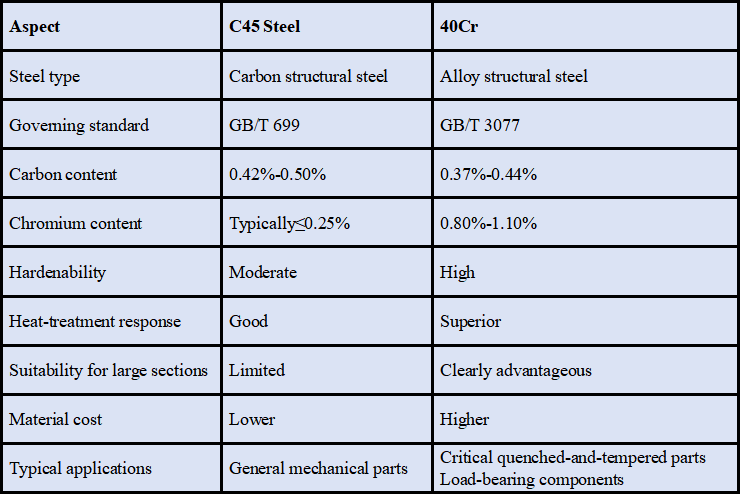
C45 steel contains about 0.42%-0.50% carbon and is classed as a high-quality carbon structural steel (GB/T 699). 40Cr, by contrast, is an alloy structural steel (GB/T 3077) with a slightly lower carbon range of 0.37%-0.44%, but with the deliberate addition of roughly 0.80%-1.10% chromium (Cr).
So here is the question that comes up time and again in workshops and procurement meetings:“If C45 steel is more affordable, why would anyone choose 40Cr?”
For smaller parts with modest loading and straightforward heat-treatment needs, C45 steel is often more than adequate - and it makes clear economic sense. But when the part grows larger in section, or when you need the core to hold strength and toughness after quenching and tempering, 40Cr begins to show its real value. The real difference is “not simply the presence of chromium”, it is that “chromium improves hardenability, allowing the heat-treatment response to reach deeper into the component”, where it matters most.
What exactly is C45 steel?
C45 steel is one of the most widely used carbon structural steels in Chinese manufacturing, specified under GB/T 699. The “45” does not mean 45% of anything–it simply indicates a nominal carbon content of about 0.45%.
According to GB/T 699-2015, the actual carbon range is 0.42%-0.50%, with small amounts of Si and Mn, while Cr, Ni, and Cu are treated as residual elements kept within controlled limits.
The most distinctive feature of C45 steel is: Cost-effectiveness, wide availability, and good machinability- and with proper heat treatment, it delivers a perfectly respectable combination of mechanical properties for a vast range of applications.
That is why you will find C45 steel in:
* General shafts and axles
* Pins and locating dowels
* Gears with moderate requirements
* Flanges and mounting plates
* Bolts and general fasteners
* Mechanical structural frames
* Ordinary transmission components
If the service conditions are not exceptionally severe, there is simply no need to pay a premium for a higher‑grade material. And that is precisely why C45 steel remains such a workhorse in the industry.
What makes 40Cr different?
40Cr is an alloy structural steel manufactured to GB/T 3077. Compared with C45 steel, its most obvious distinction is the intentional addition of 0.80%-1.10% chromium. Its carbon content is typically 0.37%–0.44%, with Si and Mn at levels comparable to C45 steel.
There is one easily overlooked issue here: 40Cr is not just “C45 steel with a pinch of chromium thrown in”. The chromium serves a very specific metallurgical purpose–it “significantly increases the hardenability” of the steel. This means that after quenching, 40Cr can develop a much deeper hardened layer, even in thicker sections.
For small parts, you may not notice this advantage at all. But once the component size increases, or when the core itself must carry meaningful load, that extra hardenability becomes a game‑changer.
So, What is the single biggest difference between them?
C45 steel gives you economy and practicality; 40Cr gives you depth – deeper hardening, deeper strength, and deeper performance after heat treatment.
Property comparison:
Why does 40Cr harden so much better than C45 steel?
This is where the metallurgy gets interesting – and it is central to understanding the choice. When you quench a steel part, the surface cools fastest because it is in direct contact with the quenching medium. As you move inward, the cooling rate drops progressively.
If the steel does not have enough hardenability, a frustrating thing can happen: you get a beautiful martensitic structure on the outside, but the interior remains soft and under‑hardened – almost as if you had two different materials in one part.
For a tiny pin, that may not matter. But for a large‑diameter shaft, a heavy‑duty gear, or anything that transmits serious torque – the interior performance matters “just as much” as the surface.
By adding chromium, 40Cr pushes that hardening response much deeper into the section. That is why 40Cr is the go‑to choice for shafts, gears, and critical mechanical components where strength cannot be skin‑deep.
To put it another way: C45 steel is about “can we meet the specs”; 40Cr is more about “can we meet the specs all the way through the core of the part”.
What happens after quenching and tempering (Q&T)?
Quenching and tempering – often referred to simply as “quenching + high‑temperature tempering” – is not about chasing the highest possible hardness. It is about striking a “balanced combination of strength, hardness, ductility, and toughness”.
Properly quenched and tempered, C45 steel gives you solid, dependable mechanical properties. That is why it works so well for ordinary shafts and structural parts.
But when you put 40Cr through the same Q&T cycle, the result is typically a “higher overall strength‑toughness package” – especially in larger cross‑sections where C45 steel would struggle to keep up.
So if your demands: High tensile strength, High yield strength, Specific hardness levels, Good impact toughness, A hardened layer that goes deep, A part with substantial cross‑section. Steel 40Cr will almost always be the more capable candidate.
If C45 steel is cheaper, why not use it for everything?
That is a fair question – and one that many procurement professionals ask early in their careers. If C45 steel already meets the design requirements, then using 40Cr would be overspecification, pure and simple – and that is not good engineering.
For example: a medium-sized shaft in a general-purpose machine, with moderate loads and a benign operating environment. If the design calculations say that C45 steel, properly Q&T, will comfortably deliver the required strength, hardness, and toughness – then choosing C45 steel is not a compromise. It is a rational decision.
Because good material selection is never just about performance. It is about balancing: performance adequacy + cost realism + machinability + supply reliability. The most expensive material is not the best material. The right material is the one that meets all service requirements while keeping total cost under control.
When Should You Lean Toward 40Cr?
There are several clear signals that point to 40Cr as the smarter choice.
1. The part has a large cross‑section
As section thickness increases, internal cooling during quenching slows down. Hardenability becomes the limiting factor – and that is exactly where 40Cr shines.
2. The part carries substantial load
When a component is subject to high tensile, bending, torsional, or impact loads, surface hardness alone is not enough. The core must contribute – and that requires deep, uniform hardening.
3. Quenching and tempering is specified
If the design calls for Q&T to achieve high strength and toughness, 40Cr gives you much more process flexibility and a better property profile.
4. Fatigue performance is critical
Shafts, gears, and transmission parts often live under cyclic loading. In that regime, uniformity of structure, hardness distribution, and internal quality matter as much as static strength – and 40Cr delivers on all fronts.
5. You need consistent, reliable performance across the entire section
For critical components, you do not want to gamble on marginal hardenability. 40Cr provides a wider and more stable performance window.
When is C45 steel the more sensible pick?
General structural parts: where loading is moderate and requirements are straightforward.
Small‑to‑medium shafts: where the section is thin enough that C45 steel can be fully hardened through.
Cost‑sensitive batch production: when you are making large quantities and the material cost difference directly affects your bottom line.
Parts that do not demand high hardenability: if the component is small and the design is already validated with C45 steel, upgrading to 40Cr adds cost without adding real value.
FAQ – Quick Answers to Common Questions
1. Which one is stronger – C45 steel or 40Cr?
Under proper heat treatment, 40Cr generally offers higher strength and toughness, particularly in larger sections, because of its superior hardenability. However, actual strength depends on part size and the specific Q&T cycle – not just the grade.
2. Why is 40Cr more expensive?
Because it contains 0.80%–1.10% chromium, which improves hardenability and heat‑treatment response. The alloy addition, combined with tighter process control, increases production cost.
3. Can I use C45 steel instead of 40Cr?
Not without technical verification. If the design relies on the deep hardening and core strength that only 40Cr can provide, substituting C45 steel may compromise component performance.
4. Is 40Cr always more wear‑resistant?
Not automatically. Wear resistance depends on hardness, microstructure, surface treatment, and the specific friction conditions. 40Cr’s main advantage lies in hardenability and overall mechanical performance, not specifically in wear resistance.
5. Is C45 steel suitable for shafts?
Yes – absolutely. It has been used successfully for decades in countless shaft applications.
For larger or more heavily loaded shafts, however, 40Cr or other alloy steels should be evaluated.
Both C45 steel and 40Cr are excellent engineering materials – each in its own place:
C45 steel gives you dependable performance at a sensible cost.
40Cr gives you the extra depth and strength that demanding applications require.
Good material selection is not about chasing the highest specification – it is about achieving the “best possible match between material capability and actual service requirements”, while balancing performance, reliability, and cost.
At DONGGUAN VIM STEEL, that is exactly the kind of balanced, application‑driven approach we bring to every customer enquiry.
Contact us: info@dgvimsteel.com
Whatsapp: +86 13423121371


Comments