
AISI 1045 Steel: Uses, Equivalent Grades and a Practical Buyer Guide

Today, let’s talk about the commercial question: when is 1045 the right purchase, when should the buyer move to another material, and what must appear on the inquiry?
1045 succeeds as a balanced medium-carbon steel. It can be economical for a machined shaft and wear-resistant at an induction-hardened journal, but it is a poor shortcut for a thick high-fatigue 4140 part, a corrosion-resistant 17-4PH shaft or an H13 extrusion die.
What is AISI 1045 Steel used for?
Common AISI 1045 steel uses include:
• shafts, axles and spindles;
• pins, studs, bolts and machine keys;
• gears, sprockets and couplings under moderate duty;
• rollers, guide rods and hydraulic components;
• crank and connecting components where the design allows;
• forgings, flanges and general machine parts;
• induction-hardened journals, tracks and teeth;
• mold-base support, fixture and transmission components.
It should be upgraded when the design requires deep hardenability, severe fatigue resistance, chhsgfjklafikpextensive welding, hot-work performance or stainless corrosion resistance.
AISI 1045 vs 1018
1018 is a low-carbon steel with better welding and cold-forming tolerance. It is common in welded structures, brackets, spacers, bushings and lightly loaded machined parts. Its lower carbon level limits the hardness obtained by conventional direct quenching, although carburizing or other surface-treatment routes may be used.
1045 contains substantially more carbon. That raises achievable strength and makes induction hardening practical. It is usually the stronger choice for shafts, pins and wear surfaces when welding is limited.
Choose 1018 when:
• the assembly involves substantial welding;
• cold forming is important;
• loads and wear are modest;
• surface hardening will use a case-hardening process;
• low processing risk matters more than maximum strength.
Choose 1045 when:
• moderate core strength is needed;
• local surface hardening is desirable;
• the part is machined rather than heavily formed;
• welding can be avoided or controlled;
• the section is compatible with 1045 hardenability.
AISI 1045 vs 4140
4140 is a chromium-molybdenum alloy steel. Its alloy additions improve hardenability, allowing a more consistent heat-treated response in larger sections. It is often selected for high-stress shafts, heavy-duty transmission parts, fatigue-loaded components and parts requiring a stronger core after quenching and tempering.
1045 is generally less expensive and simpler to source. For a moderate-size shaft or induction-hardened surface, it may provide everything the design needs.
4140 deserves evaluation when:
• the section is too thick for reliable 1045 core properties;
• the part sees high alternating bending or torsion;
• impact and fatigue consequences are serious;
• a specified quenched-and-tempered strength must be maintained through the section;
• the current 1045 part is failing below the surface rather than merely wearing.
A harder 1045 surface does not solve a core-strength problem and may increase cracking risk.
AISI 1045 vs 1.4542 / 17-4PH
EN 1.4542, also known as 17-4PH or UNS S17400, is a precipitation-hardening stainless steel. It can provide high strength, dimensional stability and useful corrosion resistance after an appropriate aging treatment. Typical applications include valve parts, precision shafts, fasteners and machinery exposed to environments that would quickly rust bare carbon steel.
1045 is not a low-cost equivalent. Replacement is possible only if corrosion resistance is unnecessary and all strength, fatigue, temperature and maintenance requirements remain satisfied.
The reverse substitution is also not automatic. 17-4PH costs more, has different machining and heat-treatment behavior, and must be specified by condition—such as Condition A, H900, H1025 or H1150. “Use stainless instead” is not an engineering specification.
Distributors should ask about the environment first. An economical shop shaft may suit 1045; humidity, salt spray or a corrosive process may justify a protective system or stainless grade.
Why 1045 is not an H13 or 1.2344 substitute
Aluminum extrusion plants may use 1045 in support blocks, pins, fixtures and transmission parts. H13 / 1.2344 is instead designed for hot strength, temper resistance and thermal fatigue under repeated heating and cooling.
Use 1045 for economical mechanical or support functions when the temperature and loading allow. Evaluate H13, 1.2344, 1.2367 or another purpose-designed grade for tooling that contacts hot aluminum or experiences severe thermal cycling.
Are 1045, S45C, C45E and 45 Steel equivalent?
They are commonly treated as near equivalents, not unconditional duplicates.
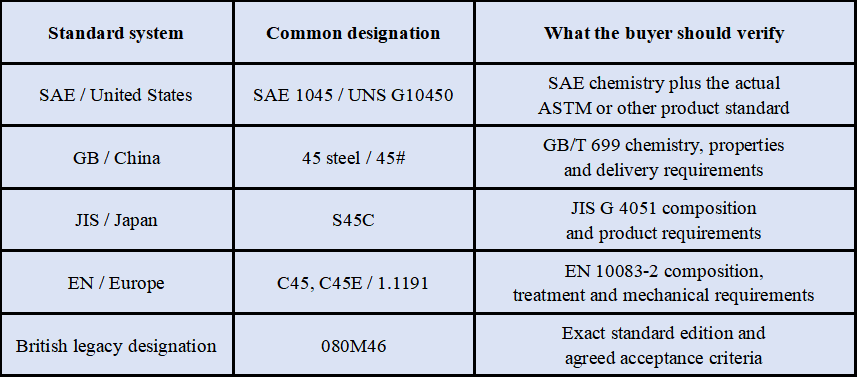
Cross-reference tables group them together because of similar carbon level and purpose. Differences may remain in manganese, residuals, mechanical-property tables, test locations, tolerances, decarburization and inspection.
A better clause is:
Alternative grades may be proposed, but the supplier shall identify the governing standard, chemistry, delivery condition, mechanical-property requirements and deviations for written buyer approval before supply.
Product form changes the purchasing standard
1045 is supplied as hot-rolled, cold-finished or turned bar, flat, plate under an applicable specification, forging stock or finished forging. One chemistry designation does not place every product under one standard.
Examples commonly encountered include:
• ASTM A576 for hot-wrought special-quality carbon steel bars;
• ASTM A108 for cold-finished carbon and alloy steel bars;
• ASTM A29/A29M for general requirements referenced by hot-wrought bar specifications;
• customer or industry specifications for heat-treated, forged or specially tested products.
Check the current revision, scope and size range; an old drawing may name a standard that does not cover the requested product.
What stockists should record
A stock label and enterprise system should identify more than “1045”:
• exact designation and governing standard;
• heat number and mill;
• product form and dimensions;
• hot-rolled, normalized, annealed, cold-drawn or heat-treated condition;
• surface condition;
• country of origin where required;
• certificate location;
• remaining traceable lengths after cutting.
Normalized and quenched-and-tempered bar should not share one stock identity. Cut pieces must retain heat-number traceability.
What aluminum extrusion plants should buy as 1045
1045 may suit general shafts, couplings, rollers, pins, fixture bodies and noncritical support components. Induction hardening can improve local wear resistance on journals and guide areas.
It should not be selected by habit for:
• extrusion dies and inserts in direct hot service;
• heavily fatigue-loaded main shafts without section analysis;
• cooling-water parts exposed to corrosion without protection;
• extensively welded frames better served by lower-carbon steel.
What mold factories should check
1045 can be economical for supports, spacers, pins or drive parts. For induction-hardened wear areas, define case depth and final grinding.
Do not use 1045 as a generic substitute for:
• P20-type mold steel where polished cavity quality and uniformity matter;
• D2 or DC53 for high-wear cold-work edges;
• H13 / 1.2344 for thermal-fatigue resistance;
• stainless mold steel in corrosive molding or humid service.
AISI 1045 RFQ
A quotation request should include:
1. Grade: SAE 1045 / UNS G10450.
2. Product standard and revision.
3. Product form: round, flat, cold-drawn bar, forging or other.
4. Diameter, thickness, length and quantity.
5. Dimensional tolerance, straightness and surface condition.
6. Delivery condition: hot rolled, annealed, normalized, cold drawn, or quenched and tempered.
7. Required tensile, yield, impact or hardness properties.
8. Surface-hardening pattern and effective depth, if applicable.
9. Machining allowance and decarburization control.
10. Heat-number traceability and material certificate.
11. UT, magnetic-particle, dimensional or third-party inspection.
12. Whether near-equivalent grades are permitted.
13. Packing, rust prevention and destination.
14. Required delivery date and cut-length schedule.
FAQ
What is the closest equivalent to AISI 1045?
S45C, C45E / 1.1191, Chinese 45 steel and 080M46 are common cross-reference grades. They are near equivalents and must be compared under their actual standards before substitution.
Is 1045 suitable for shafts?
Yes, for many moderate-duty shafts. Diameter, fatigue, core strength, surface hardness, straightness and corrosion exposure should be defined.
Is 1045 cheaper than 4140?
It is generally lower cost, but finished cost also depends on machining, heat treatment, inspection and failure risk.
Can 1045 replace 17-4PH?
Not directly. The substitution is possible only after confirming that corrosion resistance is unnecessary and all mechanical, heat-treatment and maintenance requirements remain satisfied.
Contact us: info@dgvimsteel.com
Whatsapp: +86 13423121371


Comments