
4130 Steel: The Story of Chromoly from Aircraft Frames to Industrial Work

SAE 4130 is a chromium-molybdenum low-alloy steel, widely known as chromoly. It became closely associated with welded aircraft-quality tubing and remains useful where a component needs a balance of strength, toughness, heat-treatment response and fabrication potential. It is not stainless steel, not a universal substitute for tool steel, and not a grade that should be purchased without specifying condition, dimensions and test requirements.
There are steels that become famous because they are the strongest. Others become famous because they resist corrosion, wear or extreme heat.
4130 became famous for a more practical reason: it gave engineers a workable balance.
It could be made into thin-wall tube. It could be fabricated into a welded frame. It could be heat treated when higher strength was needed. And, when specified and welded correctly, it could serve in applications where ordinary carbon steel was no longer enough.
That is why the story of 4130 runs through aircraft tubing, racing structures, industrial machinery and oilfield equipment. It is not a miracle material. It is a steel that earned a reputation by solving real engineering trade-offs.
The Beginning: Why Aircraft Builders Needed Better Steel
In the early era of metal aircraft structures, weight and reliability pulled engineers in opposite directions.
A heavier frame might be stiff, but it reduced useful payload. A lighter material could improve performance, but only if it could withstand vibration, repeated loading and the stresses concentrated around joints.
By 1929, chromium-molybdenum steel tubing was already the subject of an SAE technical paper on fuselage construction. SAE’s later aircraft-material specifications also show how established 4130 had become in aircraft-quality tubing: one SAE 4130 welded-tubing specification was first issued in November 1969 and describes aircraftquality low-alloy steel tubing, while related seamless 4130 tubing specifications trace back to December 1939.
That history matters because it explains what 4130 was valued for. It was not chosen simply because “chromoly sounds premium.” It was chosen because tubing, joints, strength and manufacturability had to work together.
Today, aircraft builders still use 4130 tubing in many tube-and-fabric airframe designs. The Experimental Aircraft Association describes 4130 chromium-molybdenum tubing as the standard material used in many such aircraft structures, while the FAA and aviation industry still recognise 4130 in aircraft-related material contexts.
What Does “4130” Mean?
SAE 4130 is a chromium-molybdenum low-alloy steel. SAE material specifications identify it as a steel with approximately 0.95% chromium, 0.20% molybdenum and 0.27–0.33% carbon.
In everyday industry language, it is called:
4130 steel
4130 chromoly
chrome-moly steel
Cr-Mo steel
The last two digits—“30”—refer broadly to the nominal carbon content near 0.30%. The 41xx family is associated with chromium-molybdenum alloy steels; it should not be interpreted as a formula proving that every 41xx grade has exactly the same alloy balance. SAE J404 is the governing SAE composition standard for many primary wrought alloy-steel forms.
Is 4130 the same as 30CrMo?
In Chinese and international trade, 30CrMo is commonly cross-referenced with SAE/AISI 4130. Their typical chromium and molybdenum ranges are close, and Baosteel’s published grade comparison places 30CrMo and 4130 in corresponding Cr-Mo alloy-steel groupings.
However, “equivalent” should not be treated as “automatically interchangeable.”
Before substituting 30CrMo for 4130, or the reverse, confirm:
governing standard;
chemistry limits;
product form;
delivery condition;
mechanical-property requirement;
test method;
certification requirement;
end-user approval.
A grade cross-reference is a useful starting point. It is not a replacement for a purchase specification.
What Makes 4130 Different from Ordinary Carbon Steel?
4130 contains chromium and molybdenum in addition to carbon and manganese. These additions give it more hardenability and a broader heat-treatment response than plain low-carbon steel.
In practical terms, 4130 can offer:
useful strength after suitable heat treatment;
good toughness when condition and processing are appropriate;
practical fabrication potential;
strong performance in thin-wall tubular structures;
a better balance between strength and weldability than some higher-carbon alloy steels.
That balance is the central reason it remains relevant.
A normalized 4130 material data set for a specified 100 mm air-cooled round, for example, lists tensile strength around 615 MPa and yield strength around 400 MPa. Those numbers are condition-specific examples, not universal guarantees for every 4130 tube, bar or forging.
The Strength Story: Why One 4130 Number Is Never Enough
A customer may ask, “How strong is 4130?”
The honest answer is: which 4130, in which condition, at what size?
4130 strength depends on:
tube, bar, plate or forging form;
wall thickness or bar diameter;
annealed, normalized or quenched-and-tempered condition;
austenitizing and quenching practice;
tempering temperature;
forging reduction;
welding history;
residual stress;
required standard and test location.
A thin-wall normalized tube, a heavy forged bar and a quenched-and-tempered shaft may all be 4130—but they should not be expected to share the same strength values.
This is where good procurement begins. Do not buy “high-strength 4130.” Buy material with a defined:
standard;
product form;
dimension and tolerance;
delivery condition;
hardness range;
tensile and yield requirement;
impact requirement, where needed;
ultrasonic requirement, where needed;
mill certificate;
third-party inspection scope.
Why 4130 Became Known in Aircraft Structures?
Aircraft structures helped turn 4130 into a familiar name because the material suited a particular construction method: welded tubular frames.
The Experimental Aircraft Association notes that 4130 chromium-molybdenum tubing is widely used in tube-andfabric aircraft, and its technical guidance stresses the importance of normalized condition for aircraft structural tubing.
This does not mean 4130 is approved for every aircraft component or that any commercial 4130 tube is automatically aviation-grade.
Aerospace work may require:
aircraft-quality material specification;
qualified tube form;
controlled chemistry;
traceable heat number;
qualified welding procedure;
inspection and documentation;
customer or regulatory approval.
The real lesson from aviation is not “4130 is an aviation steel, so any 4130 will do.” The lesson is that materials, joints and process control must be specified together.
How 4130 Moved into Racing, Bicycles and Industrial Structures?
Once chromium-molybdenum tubing became established in structural applications, the same balance attracted other industries.
Racing and vehicle structures
4130 is widely associated with high-performance chassis, roll structures and fabricated vehicle components because thin-wall tube can provide useful structural efficiency when design and welding are well controlled.
But do not write that every international racing rule “specifies 4130.” Regulations vary by sanctioning body, vehicle class, tube size, wall thickness, joining method and homologation rule.
For a racing structure, the buyer should work from the actual rulebook and the approved material specification—not from a generic social-media statement.
Bicycle frames
High-end steel bicycle frames have long used chromoly tubing because designers can work with thin-wall steel tubes and tune frame geometry for strength, durability and ride character.
The word “ride feel” is subjective. What can be stated more confidently is that a steel-frame design depends on tube diameter, wall thickness, butting, geometry, joint design and heat treatment—not only on whether the tube is labelled 4130.
Industrial and mechanical components
4130 is also used in structures and machine parts such as:
welded frames;
shafts and pins;
fittings and fixtures;
mechanical assemblies;
forgings;
load-bearing fabricated components;
drilling and energy-related equipment, subject to the applicable specification.
Producer information for 4130 tubing lists structural, automotive, oil-drilling and abrasion-related applications.
4130 in Oil and Gas: Strength Is Only One Part of the Requirement
Oil and gas service can involve pressure, impact, fatigue, corrosion, sour-service risk and difficult inspection conditions.
4130-type steel may appear in oilfield-related components, but “4130 is for high-pressure pipelines and downhole tools” is too broad to be a safe purchasing claim.
The material choice must account for:
product standard;
strength level;
toughness;
hardness;
hydrogen-related cracking risk;
corrosion environment;
sour-service requirements;
non-destructive testing;
heat-treatment record;
connection and weld design.
Baosteel’s published drill-rod-joint material information includes AISI 4130 as a grade option in an oilfield material context, while its data also illustrates why steel grade alone is insufficient: each application is governed by its own chemistry and quality requirements.
4130 vs 4140: The Difference That Matters in the Workshop
Many buyers compare 4130 with 4140 because both are chromium-molybdenum alloy steels.
The important difference is carbon content. 4140 has a higher carbon range and therefore usually has greater hardness and strength potential after suitable heat treatment. 4130’s lower carbon content
often makes it more attractive when fabrication and welding are central to the job.
Choose 4130 when the job needs:
a welded or fabricated high-strength structure;
a practical balance of strength and weldability;
a lower-carbon Cr-Mo alloy steel;
controlled heat treatment after fabrication, where appropriate.
Consider 4140 when the job needs:
higher hardness or strength potential;
a primarily machined or heat-treated component;
limited welding, or a welding procedure designed for the grade;
mechanical properties that 4130 cannot reliably achieve at the required section size.
Neither grade wins by default. The correct choice follows the component’s loading, thickness, welding route and target properties.
The Welding Lesson: 4130 Is Weldable, Not Forgiving
Here is the point where many workshop stories turn into expensive lessons.
4130 can be welded successfully. But it should never be described as a steel that “must always be welded with one fixed preheat” or as a material that can be welded without a qualified procedure.
Welding risk increases with:
thicker sections;
restrained joints;
hardened or quenched-and-tempered material;
high carbon-equivalent effects in the actual heat;
high-strength design targets;
low-hydrogen control problems;
fast cooling;
fatigue-sensitive service.
Lincoln Electric publishes 4130-related welding consumable guidance that calls for preheat and interpass control in a stated application. That document is valuable evidence of why procedure control matters, but it is not a universal preheat instruction for every 4130 thickness or joint.
What should be agreed before welding 4130?
For serious fabrication, confirm:
1. starting material condition;
2. section thickness;
3. joint restraint;
4. filler metal;
5. preheat and interpass range;
6. hydrogen-control practice;
7. heat input;
8. cooling rate;
9. post-weld heat treatment, if needed;
10. inspection and mechanical testing.
A weld that looks fine on day one can still become the weak point after cyclic loading if the heat-affected zone, residual stress and post-weld condition were not controlled.
That is not a flaw unique to 4130. It is the reality of welding alloy steel for structural service.
What 4130 is not
4130 has a wide application range. That does not make it a universal steel.
It is not stainless steel
4130 contains chromium, but it is not a corrosion-resistant stainless grade. Its chromium supports hardenability, not stainless-steel corrosion performance.
Do not substitute 4130 for 1.4542 / 17-4PH merely because both can be used for high-strength parts.

If the service environment includes moisture, salt, chemicals or outdoor exposure, 4130 usually needs coating, painting, plating or another corrosion-control system.
It is not a hot-work tool steel
4130 should not be treated as a substitute for H13 / 1.2344, SKD61, 1.2367 or other dedicated hot-work die steels.
Those tool steels are selected for properties that primary hot tooling needs:
elevated-temperature strength;
resistance to softening;
resistance to heat checking;
thermal-fatigue resistance;
hot wear resistance;
a specific hardness–toughness balance.
For an aluminium extrusion plant, 4130 can be useful in fixtures, support structures, shafts, pins, clamps and maintenance components. It is not normally the first choice for the primary high-temperature die, mandrel or other severe hot-work position.
The Stockholder’s View: What Makes One 4130 Order Different from Another?
A stockholder may receive two enquiries for “4130 round bar” that appear identical at first glance.
They are not identical if one customer needs:
a normalized machining bar;
a low-sulfur heat;
a 3.1 mill certificate;
ultrasonic testing;
precise straightness;
third-party inspection;
cut lengths;
traceability for a fabricated pressure component.
The grade name opens the conversation. The specification closes it.
A practical 4130 purchase checklist
For a technical quotation, provide:
material standard;
4130, 30CrMo or approved equivalent designation;
product form: round bar, flat bar, seamless tube, welded tube, forging or cut piece;
dimensions and tolerance;
quantity;
delivery condition: annealed, normalized, quenched and tempered or stress relieved;
target hardness and mechanical properties;
machining, forming and welding plan where relevant;
ultrasonic or internal-quality requirement;
corrosion-protection requirement;
mill test certificate requirement;
heat-number traceability;
third-party inspection scope;
destination and packing details.
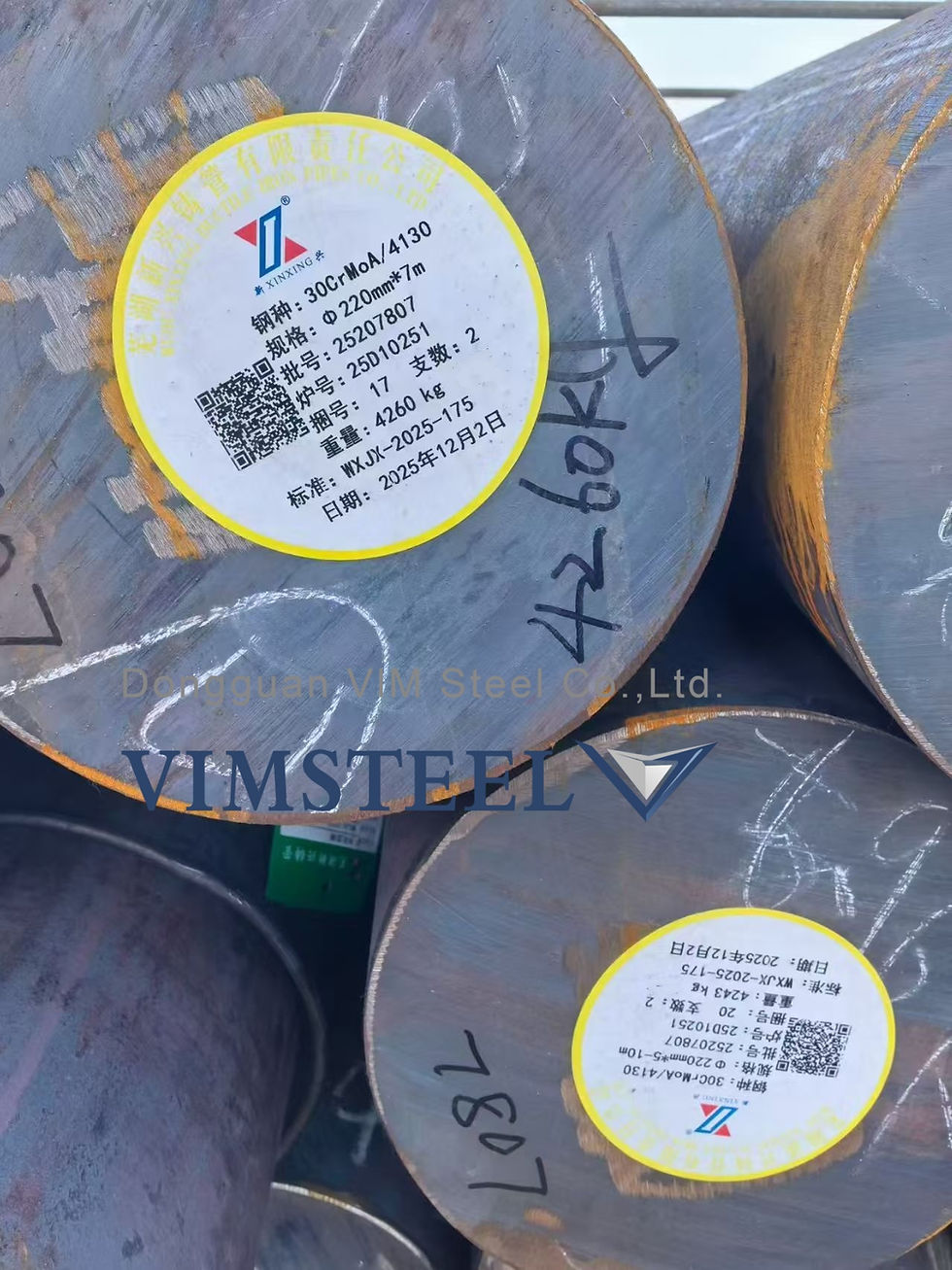
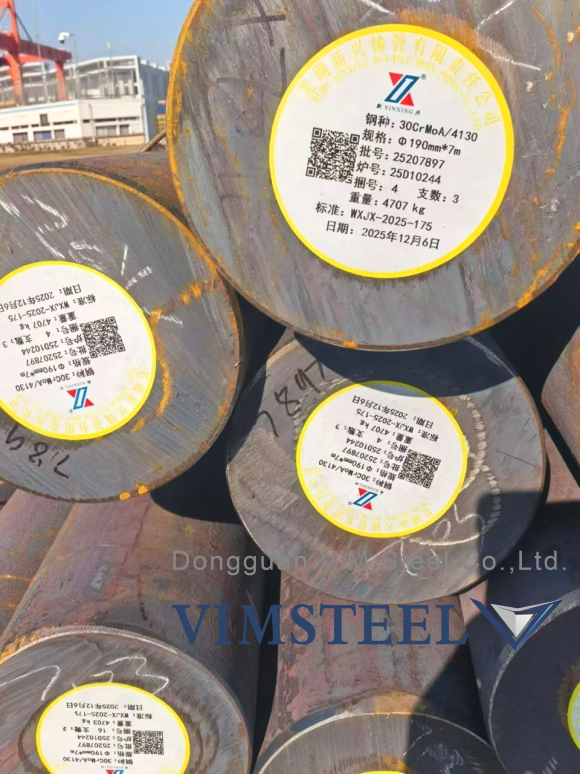
DONGGUAN VIM STEEL: 4130, 30CrMo and Specialty Steel Supply
DONGGUAN VIM STEEL supports stockholders, fabricators, aluminium extrusion plants, mould manufacturers and industrial distributors with alloy-steel, tool-steel and specialty stainless-steel enquiries.
For 4130 or 30CrMo procurement, the most useful enquiry includes the exact standard, product form, dimensions, condition and inspection requirement.
Customers comparing 4130 with 4140, H13 / 1.2344, 1.2367 or 1.4542 / 17-4PH should define the real operating environment first:
Is welding central to the job?
Is corrosion resistance required?
Will the part see elevated temperature?
Is high hardness or wear resistance the main concern?
Is the component thin-wall tubing, a large forging or a machined shaft?
Which documents must travel with the material?
That is how a buyer avoids paying for the wrong steel—or saving money on a material that cannot perform in service.
Frequently Asked Questions
What is 4130 steel used for?
4130 is commonly used in welded tubular structures, fabricated frames, shafts, pins, forgings, aircraft-quality tubing applications and other heat-treatable mechanical components. The final application must still follow its own governing specification.
Is 4130 the same as 30CrMo?
30CrMo and SAE 4130 are commonly cross-referenced as corresponding Cr-Mo alloy steels, but the governing standards and order requirements must be checked before substitution.
Why is 4130 called chromoly?
The name comes from the steel’s chromium and molybdenum alloy additions.
Is 4130 stronger than mild steel?
4130 generally has greater hardenability and greater heat-treated strength potential than typical mild steel. Actual strength still depends on product form, section size and heat treatment.
Is 4130 easier to weld than 4140?
4130’s lower carbon content often makes it the more practical choice when fabrication and welding are important. Both grades require welding procedures suited to the actual condition, thickness and service requirement.
Does 4130 always need preheat before welding?
No single preheat temperature applies to every 4130 job. Thickness, restraint, material condition, filler, hydrogen control and final properties determine the procedure. For critical work, use a qualified welding procedure.
Is 4130 stainless steel?
No. 4130 is a chromium-molybdenum low-alloy steel. It requires separate corrosion protection in corrosive environments.
Can 4130 replace 1.4542 / 17-4PH?
Not directly. 1.4542 / 17-4PH is selected for high strength plus useful corrosion resistance, while 4130 is a low-alloy Cr-Mo steel.
Can 4130 be used for aluminium extrusion dies?
It may be useful for support parts, fixtures, pins, shafts and fabricated maintenance components. It is not normally a direct replacement for the dedicated hot-work tool steels used in primary high-temperature die positions.
Contact us: info@dgvimsteel.com
Whatsapp: +86 13423121371


Comments