
17-4PH Stainless Steel: Why Engineers Keep Choosing It for Demanding Parts

17-4PH is a martensitic precipitation-hardening stainless steel known as UNS S17400, AISI 630 and, in many European specifications, 1.4542. Its main advantage is not one record-breaking property. It is the ability to combine high strength, useful corrosion resistance, practical machinability and controllable heat-treatment response in the same material.
Some alloys are selected because they solve one extreme problem. Others remain popular because they solve several ordinary engineering problems at once.
17-4PH belongs to the second group. It appears in aircraft hardware, pump components, valves, shafts, tooling and surgical instruments because designers can machine it in a relatively workable condition and then select an ageing condition that matches the job. The part does not have to trade away all corrosion resistance to gain strength, nor does it require the same heat-treatment route used for conventional quenched-and-tempered structural steel.
That practical balance has made 17-4PH one of the most widely recognised precipitation-hardening stainless steels.
What is 17-4PH stainless steel?
The name comes from its approximate chromium and nickel content: around 17% chromium and 4% nickel. Copper is the principal precipitation-hardening addition, while niobium and tantalum are also controlled within the alloy specification.
Common designations include:
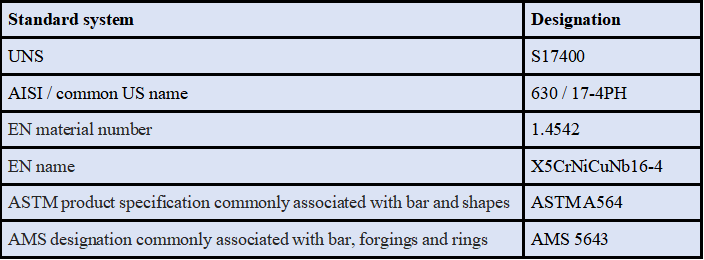
The exact equivalence must always be checked against product form, governing standard, chemistry and mechanicalproperty requirements. A familiar grade name alone is not enough to approve substitution. voestalpine identifies 17-4PH as S17400, 1.4542 and AISI 630, while also listing relevant ASTM and AMS specifications.
How does 17-4PH become so strong?
17-4PH does not follow the classic “quench, then high-temperature temper” route used for many alloy steels. Its standard strengthening route is solution treatment followed by ageing.
During solution treatment, strengthening elements are brought into solution. Cooling produces the martensitic matrix required for the next stage. Ageing then forms fine copper-rich precipitates that obstruct dislocation movement and raise the strength and hardness of the steel. voestalpine describes this sequence as solution annealing to dissolve precipitates, followed by an ageing cycle that creates the strengthening precipitates.
This distinction is important. It is inaccurate to say that 17-4PH needs “only low-temperature ageing” in every case. Ageing is the convenient final strengthening step, but the material must first be in the correct solution-treated condition.
For additive-manufactured 17-4PH, EOS similarly specifies a two-stage route: solution annealing followed by ageing. Its published process data uses approximately 1040°C for solution annealing and lists ageing schedules from H900 through H1150. Exact instructions for wrought plate, bar, forgings or printed parts must come from the applicable material and product specification.
What do H900, H1025 and H1150 mean?
The “H” condition identifies the ageing treatment. In the US naming system, the number broadly refers to the ageing temperature in degrees Fahrenheit.
The familiar conditions include:
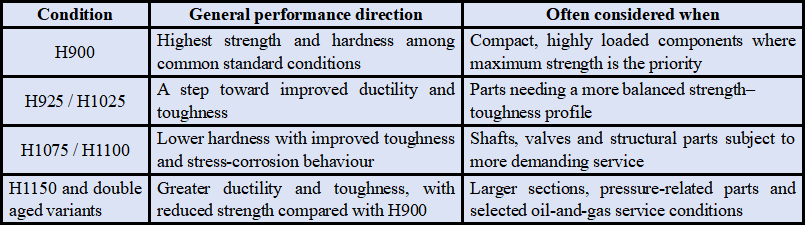
The correct condition cannot be chosen from tensile strength alone. The designer must also consider fracture toughness, stress-corrosion cracking, fatigue, section size, operating temperature and dimensional requirements.
Four reasons 17-4PH works well in real components
1. High strength without making the material impractical
In high-strength ageing conditions, 17-4PH can exceed 1100 MPa in tensile strength, depending on the product form, specification and processing route. For example, EOS reports room-temperature tensile values above 1300 MPa for its H900-treated additively manufactured material. These numbers should not be copied directly into a wrought-material purchase order, but they demonstrate the strengthening capability of the alloy.
The more useful engineering point is adjustability. A lower ageing temperature generally favours higher strength and hardness; a higher ageing temperature trades some of that strength for improved ductility and toughness.
2. Corrosion resistance that remains useful at high strength
17-4PH offers good general corrosion resistance for a high-strength stainless steel. It is used where carbon steel would need additional protection and where conventional martensitic stainless grades may not provide the desired combination of corrosion resistance and mechanical strength. Carpenter Technology describes 17-4PH as a martensitic precipitation-hardening stainless steel offering high strength and hardness together with excellent corrosion resistance.
This does not make the alloy immune to corrosion. Chloride concentration, temperature, surface finish, crevices, residual stress and ageing condition all influence performance. For warm chloride environments, seawater immersion or strong acids, a corrosion review and application-specific testing remain necessary.
Claims such as “better salt-spray resistance than 430” are meaningful only when the specimen preparation, surface finish, ageing condition and test standard are identical. Without those controls, the comparison is too broad to support a material decision.
3. A production-friendly heat-treatment sequence
A major attraction of 17-4PH is that substantial machining can be completed in the solution-treated condition, followed by a comparatively low-temperature ageing cycle. The ageing response allows manufacturers to target different strength levels without using a separate alloy for every load case.
Voestalpine describes the grade as having excellent machinability and the ability to be hardened to different strength levels. Welding is also feasible with an appropriate procedure, although joint design, filler selection, pre-weld condition and post-weld heat treatment must be matched to the required properties.
“Easy to process” should therefore be understood as production-efficient when the process route is planned correctly, not as permission to ignore welding qualification or heat-treatment control.
4. Relatively predictable dimensional response
Ageing takes place at a lower temperature than solution treatment and typically causes less distortion than a full high temperature reheat followed by severe quenching. This is valuable for precision parts, finished machining allowances and repeated batch production.
Dimensional change is not zero. EOS reports a typical heat-treatment dimensional change of approximately +0.2% for a specific additive-manufacturing process, while other product forms and heat-treatment routes may behave differently. Critical components should use process qualification, representative coupons and a defined machining allowance rather than relying on a generic shrinkage or growth figure.
Where is 17-4PH commonly used?
Aerospace and aircraft hardware
High strength, corrosion resistance and controllable heat-treatment conditions make 17-4PH relevant to loaded aircraft and aerospace hardware. Typical examples include fittings, fasteners, brackets, shafts, valve parts and selected turbine-related components.
The alloy designation alone does not qualify a part for flight. Aerospace use normally requires a specified melt route, product standard, heat-treatment condition, inspection plan and full traceability.
Medical instruments and equipment components
17-4PH is used for surgical tools and other medical-field components where strength, hardness and corrosion resistance are useful. EOS lists surgical tools among its applications and reports cytotoxicity testing for its specific additively manufactured 17-4PH process.
That evidence is process-specific. It should not be stretched into a blanket claim that every 17-4PH product is suitable for permanent implantation. Implant use requires separate biological evaluation, surface-condition control, manufacturing validation and compliance with the applicable medical-device requirements.
Oil, Gas, Chemical and Energy Equipment
The alloy is found in pump components, valve parts, high-strength shafts and other equipment that combines mechanical loading with moderate corrosion exposure. Voestalpine notes that it stocks H1150M and double-H1150 conditions for NACE-related service, illustrating how the ageing condition can be tailored to a particular operating environment.
For sour service, high-chloride fluids or pressure boundaries, the material condition and hardness limits must be checked against the governing specification. “17-4PH” by itself is not a complete sour-service requirement.
Moulds, dies and general machinery
Mould inserts, tooling, wear-loaded machine parts, gears and high-strength couplings can benefit from the alloy’s combination of hardness, polishability, corrosion resistance and dimensional control. It can be especially useful where a carbon tool steel would deliver hardness but create maintenance problems in a wet or mildly corrosive environment.
Can 17-4PH work from − 40°C to 400°C?
A single universal temperature range should not be advertised for every 17-4PH product and condition.
Low-temperature toughness changes substantially with ageing condition, section size and manufacturing route. At the upper end, prolonged exposure can over-age the material and alter its mechanical properties. Published supplier guidance for standard 17-4PH products commonly limits prolonged service to around 300°C, although the exact boundary depends on the specification and design requirement.
Thermal-property data may be published up to 400°C, but the existence of data at that temperature does not automatically certify long-term structural service there. An operating-temperature claim should be tied to the selected condition, required design life and code calculation.
17-4PH compared with 304, 316 and 430

17-4PH is not automatically “better” than these grades. It is better suited to a different problem. If the component is lightly loaded but continuously exposed to aggressive chlorides, 316 or a more highly alloyed grade may be the safer choice. If the part needs high yield strength, compact dimensions and controlled heat treatment, 17-4PH becomes much more compelling.
What should a buyer specify?
A useful enquiry or purchase order should include more than the words “17-4PH stainless steel.”
Specify:
the required designation and governing standard;
product form, dimensions and tolerances;
solution-treated or aged delivery condition;
required H condition or mechanical-property range;
hardness limits where relevant;
melting or remelting requirements, if applicable;
surface condition and machining allowance;
ultrasonic, penetrant or other inspection requirements;
material certificate and heat-treatment records;
third-party inspection scope, if required;
end-use temperature and corrosion environment.
This information gives the supplier a measurable target and reduces the risk of receiving the correct alloy in the wrong condition.
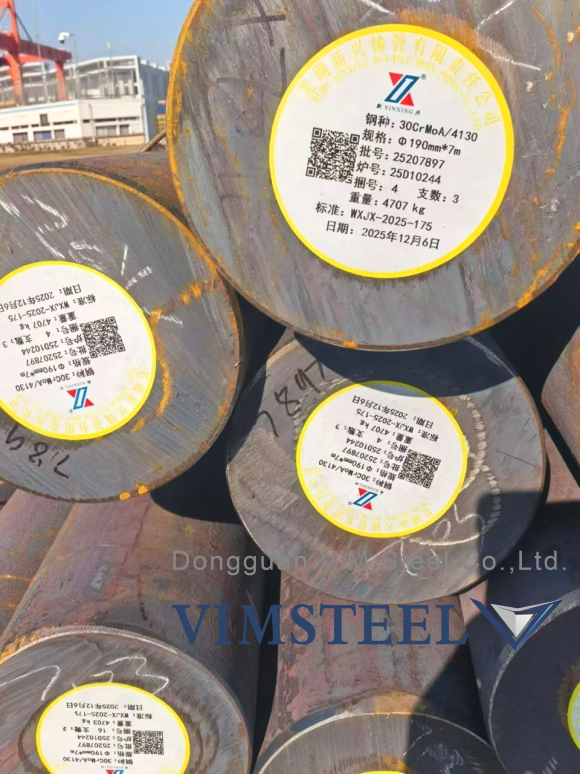
Sourcing 17-4PH / 1.4542 from DONGGUAN VIM STEEL
DONGGUAN VIM STEEL supplies and exports specialty stainless steels, including 17-4PH / 1.4542 and other grades for demanding engineering applications.
Third-party inspection can be arranged according to the agreed standard, inspection scope and order requirements. Buyers may also request relevant material certificates, dimensional inspection records and other traceability documents as part of the commercial agreement.
For a faster technical review, include the product form, dimensions, quantity, required H condition, governing standard, destination and inspection requirements with the enquiry.
Frequently asked questions
Is 17-4PH the same as 1.4542?
They are commonly treated as corresponding designations: 17-4PH / AISI 630, UNS S17400 and EN 1.4542. Exact equivalence must still be confirmed against the governing standard and product form.
Does 17-4PH need quenching and tempering?
Not in the conventional alloy-steel sense. Its characteristic strengthening route is solution treatment followed by ageing. The cooling step after solution treatment helps establish the martensitic matrix; ageing then creates the strengthening precipitates.
How strong is 17-4PH?
Strength depends on the H condition, product form and specification. High-strength conditions can exceed 1100 MPa in tensile strength, while higher-temperature ageing conditions sacrifice some strength to gain toughness and ductility.
Is H900 always the best condition?
No. H900 is attractive when high strength and hardness dominate the design, but it is not automatically the best choice for toughness, stress-corrosion resistance or demanding low-temperature service.
Is 17-4PH corrosion resistant?
Yes, it provides useful general corrosion resistance combined with high strength. It can still suffer pitting, crevice corrosion or stress-corrosion cracking in unsuitable environments. Material condition and exposure details must be reviewed.
Is 17-4PH suitable for medical parts?
It is used for surgical tools and other medical-field components. Permanent implant suitability cannot be assumed from the alloy name alone and requires device-specific testing and regulatory evaluation.
Is 17-4PH easy to machine?
It is commonly machined in the solution-treated condition and then aged to the required strength. Tooling, cutting parameters and machining allowance should still reflect its work-hardening behaviour and the expected dimensional response during heat treatment.
Contact us: info@dgvimsteel.com
Whatsapp: +86 13423121371


Comments