
17-4PH H900 vs H1025 vs H1150: Hardness, Corrosion, and Condition Selection

H900 normally gives 17-4PH its highest common strength and hardness. H1025 provides a broader strength-toughness balance. H1075 and H1150 move further toward toughness and improved stress-corrosion-cracking resistance. Condition A is useful for stock and machining but should not automatically be treated as the final-service condition. The correct choice depends on loading, section size, corrosion medium, machining route, and the governing standard.
17-4PH sits between corrosion-led duplex grades and hardness-led martensitic grades. Its aging condition changes hardness, strength, toughness, dimensional response, and SCC resistance.
What is 17-4PH / 1.4542?
One alloy family, several standard designations
Common names include:
• Type 630 / 17-4PH
• UNS S17400
• EN 1.4542 / X5CrNiCuNb16-4
• JIS SUS630
• Common GB/T cross-reference 05Cr17Ni4Cu4Nb
These names identify the same general alloy family, but ASTM, EN, AMS, JIS, and GB/T product standards are not interchangeable. Requirements can also differ for bar, plate, forgings, and aerospace products.
17-4PH is a martensitic precipitation-hardening stainless steel. Carpenter data lists 3%–5% copper, 0.15%–0.45% niobium plus tantalum, and carbon not above 0.07%. Fine copper-rich precipitates formed during aging provide the main strengthening effect.
Lower-temperature aging favors hardness and strength; higher-temperature aging often improves ductility, toughness, and SCC resistance.
Condition A, H900, H1025, H1075, and H1150 compared
The following values are typical references from Carpenter’s Custom 630 data. Exact acceptance limits depend on the governing standard, product form, size, test location, and certificate.
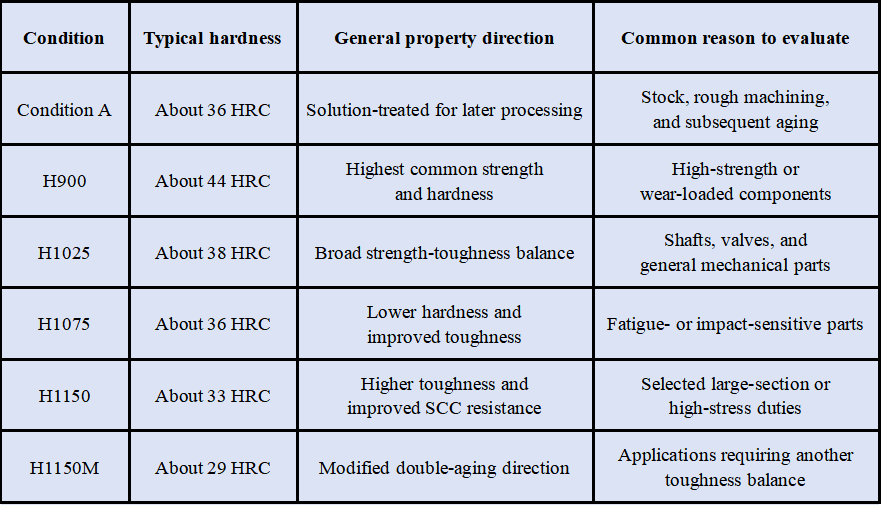
Do not copy typical values into a drawing without checking the applicable specification. Acceptance criteria vary by product form and section size.
H900 or H1025: Which one should you choose?
Choose H900 when hardness is the controlling property
H900 is normally considered for high-strength fasteners, valve components, wear-loaded parts, precision shafts, and selected aerospace or tooling components.
Its advantage is high strength and hardness. Exercise more caution with chlorides, sustained tensile stress, impact, sharp stress concentrations, and large sections. Maximum hardness adds little value when fatigue cracking or SCC controls failure.
Choose H1025 for a broader balance
H1025 remains a high-strength condition but usually provides more toughness than H900. It can suit shafts, pump and valve parts, connectors, and cyclically loaded components.
Carpenter indicates that material aged at 1025°F and above generally has better SCC resistance than lower-temperature conditions. This does not make H1025 a universal seawater or chloride solution.
The actual corrosion review still needs chloride concentration, temperature, PH, crevices, surface condition, and applied stress.
When to move toward H1075 or H1150
H1075 and H1150 trade hardness for toughness and a different stress response.
Consider them when:
• Impact or fatigue matters more than maximum hardness
• The component has a larger cross-section
• Residual or applied tensile stress is significant
• Welding or repair history affects the design
• The drawing requires a higher aging temperature
• Improved SCC resistance is part of the requirement
H1150 should not be sold as “the corrosion-resistant condition” without qualification. It can improve SCC behavior relative to H900, but it does not turn 17-4PH into 2507 or another highly alloyed corrosion-resistant grade.
H1150M uses a modified double-aging route. Order it only when the governing standard or customer specification defines the required process and properties.
Safety-critical sour oil and gas, nuclear, and aerospace applications must follow the current project specification and qualified-material list. A generic H-condition chart is not enough for approval.
Can condition A be used directly?
Flexible for processing does not mean ready for every service condition
Condition A is attractive to stockholders because downstream customers can machine the material before final aging.
However, Carpenter advises against using Custom 630 in Condition A without age hardening because it is SCC-sensitive in that state.
A safer supply-chain process is:
1. Stock Condition A when customers need machining flexibility.
2. Mark the condition on every bar, plate, and cut piece.
3. Confirm who performs aging.
4. State the final H condition on the drawing or purchase order.
5. Verify the heat-treatment cycle and final properties.
The condition must remain traceable after cutting, machining, and repacking.
Corrosion resistance and chloride limits
“Similar to 304” is not a universal promise
Outokumpu positions 17-4PH as combining high strength with corrosion resistance similar to 304 in suitable environments. Carpenter describes performance close to 302 and 304 in many media but lists seawater resistance as restricted.
A technically safer statement is:
17-4PH can offer practical corrosion resistance close to common austenitic stainless steel in many mild environments. Seawater, warm chlorides, crevices, and sustained tensile stress require separate assessment.
Changing from H900 to H1150 may improve SCC resistance, but it cannot replace duplex or super-austenitic alloy design.
When chloride exposure controls the application, compare 2205, 2507, 1.4529, or another material approved for the process medium.
Dimensional change and machining sequence
A useful feature of 17-4PH is the relatively small dimensional movement during aging. Carpenter gives typical contraction from Condition A of approximately:
• H900: 0.04%–0.06%
• H1150: 0.09%–0.12%
These values matter to precision shafts, bores, fits, and thin-wall components.
A practical sequence is:
1. Purchase traceable Condition A material.
2. Rough machine or semi-finish.
3. Leave a calculated finishing allowance.
4. Apply the specified aging treatment.
5. Measure and inspect.
6. Finish critical dimensions.
7. Record final hardness and heat-treatment traceability.
Set the allowance from geometry, section size, machining stress, equipment, and production experience.
Application
Stockholders and distributors
Condition A offers stocking flexibility; H900, H1025, and H1150 are often better supplied against confirmed orders. Record the standard, condition, heat number, size, surface, certificate, and inspection status. Quote the exact H condition and mechanical requirements, not only “17-4PH bar.”
Aluminum extrusion plants
17-4PH can be evaluated for shafts, valve parts, connectors, fixtures, and corrosion-resistant mechanical components. It is not a general substitute for H13 / 1.2344 hot-extrusion dies, which require elevated-temperature strength and thermal-fatigue resistance.
Mold factories
Consider 17-4PH when high structural strength, practical corrosion resistance, and limited aging movement are useful.
Compare 420 or 440C / 1.4125 when higher hardness, polishing, or wear leads the decision. Compare duplex or another corrosion class when chloride-bearing cooling water controls failure.
Special melting routes
ESR, PESR, and VAR are manufacturing routes, not grade names. They cannot be inferred from “17-4PH,” “S17400,” or “1.4542.”
If a remelting route is mandatory, put it in the contract and require traceable mill documentation.
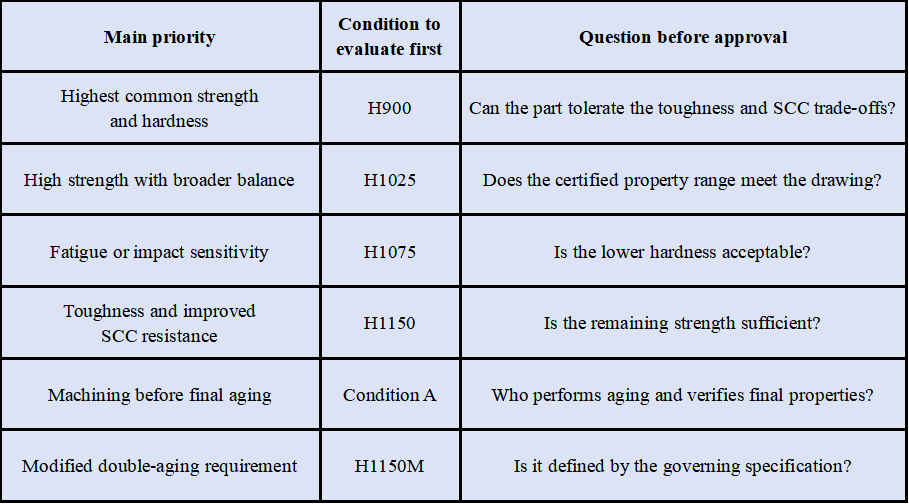
Condition selection table
Frequently asked questions
What is the main difference between H900 and H1025?
H900 normally provides higher hardness and strength. H1025 gives up some hardness for a more balanced combination of strength, toughness, and SCC resistance.
Is H1150 more corrosion resistant than H900?
It can provide better SCC resistance, but localized corrosion still depends on composition, chlorides, temperature, surface, crevices, and stress. It is not a replacement for 2507 in severe chloride service.
Can Condition A be supplied as finished material?
It can be supplied, but it should not automatically be used as the final-service condition. The order must define who performs aging and how final properties will be verified.
Is 1.4542 the same as 17-4PH?
They commonly refer to the same alloy family. The contract must still define the governing standard, product form, condition, dimensions, properties, and tests.
Can 17-4PH be used in seawater?
It should not be treated as a default seawater material. Compare duplex, super duplex, or another approved alloy when seawater or warm chlorides control the application.
Need 17-4PH / 1.4542 selection support or a quote?
DONGGUAN VIM STEEL supports stockholders, aluminum extrusion plants, mold manufacturers, and specialty stainless steel distributors with technical sourcing discussions for 17-4PH / 1.4542 and related grades.
For an accurate quotation, provide:
• Grade and governing standard
• Product form, dimensions, and quantity
• Condition A or required H condition
• Hardness and mechanical-property requirements
• Service medium and temperature
• Machining and heat-treatment responsibility
• UT, PMI, and third-party inspection
• Certificate, packing, and destination requirements
Stock, cutting, heat treatment, inspection, and documentation should be confirmed case by case according to the grade, size, quantity, standard, and contract.
Contact us: info@dgvimsteel.com
Whatsapp: +86 13423121371


Comments